

Summary
In this lesson, students investigate the relationships between the measurements of similar 3-dimensional figures and develop rules explaining the effects of scale factors on the areas and volumes of similar figures. Students then watch a career-focused video of a civil engineer who uses math to estimate the size and cost of projects. Students take on the role of a civil engineer and submit a proposal to a potential client outlining costs and comparing possible designs.
Essential Question(s)
How can we compare and measure similar 3D figures?
Learning Objectives
Discover how the measurements of similar 3D figures relate.
Use the measurements of similar 3D figures to solve problems.
Snapshot
Engage
Students play a game of Would You Rather to discuss pizza surface area.
Explore
Students investigate the differences in the volume and surface area of similar shapes on GeoGebra.
Explain
Students compare their findings from the previous activity, formalize rules governing similar figures, and practice applying those rules.
Extend
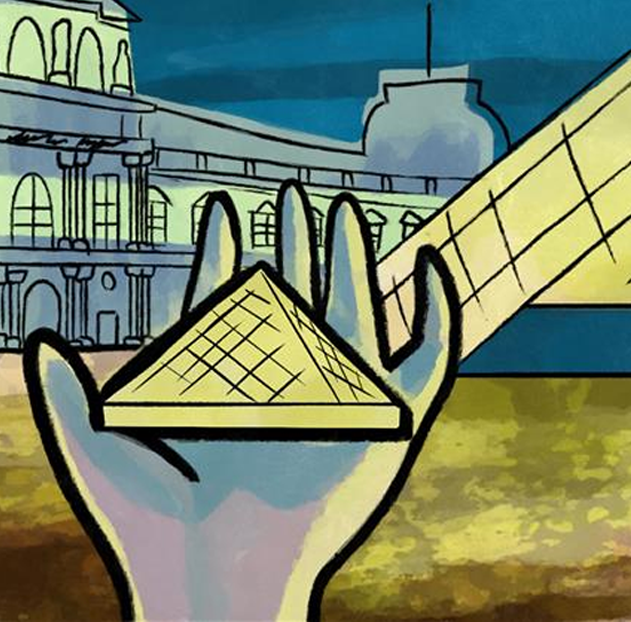
Students watch a video about shapes and civil engineering, and then work in groups to create a building modeled after the Louvre.
Evaluate
Students use their knowledge about similar figures to answer an ACT practice question.
Materials
Lesson Slides (attached)
Explore Notes (attached; one per student)
Guided Notes (attached; one per student)
Building Proposal (attached; one per student)
Exit Ticket (attached; one half-sheet per student)
Engage
10 Minute(s)
Use the attached Lesson Slides to guide students through the lesson. Display slide 2 and introduce students to the lesson. Use slides 3–4 to go over the essential question and lesson objectives. Move to slide 5 and explain to students the game Would You Rather. Use slides 6–8 to engage students in choosing and discussing their rationale. On slide 9, take time to have students discuss which pizza they would rather have and give their reasons why.
Explore
30 Minute(s)
Move to slide 10 and remind students what it means for two shapes to be similar versus congruent. Note that congruent means that two figures have the same size and shape, while similar figures have the same shape but are different (proportional) sizes.
Have students pair up or assign partners to students. Pass out a copy of the Explore Notes to each student. Transition to slide 11 and ask students to navigate to the GeoGebra activity, Investigating Similar Figures, using the URL on the slide. Display the formulas for volume and surface area on slide 12 to assist students as they work through the activity.
Walk about the room and assist students where needed, and remind them to fill in the information on their notes. When students are finished calculating the volume and surface area for the figures, instruct them to answer the reflection questions on the back of their notes with their partner. Ask students to share their responses to the questions with another pair.
Use slides 13–14 to facilitate a discussion with the whole class about what they found during the activity.
Explain
15 Minute(s)
Pass out a copy of the Guided Notes handout to each student. Use slides 15 & 16 to explain to students the rule of increasing volume with similar figures. Discuss with students when you multiply the length of a figure by r, then it multiplies the area by r² and the volume by r³. Move to slides 17–20 to provide students with sample problems.
Extend
25 Minute(s)
Transition to slide 21 and play the video interview with the civil engineer. Facilitate a discussion with students about how similar shapes are used in engineering.
Move to slide 22 and explain to students that they will imagine they are an engineer. They have been given the task of designing a new building based on the Louvre in Paris. Explain that they will need to determine the cost and energy efficiency of the building at different sizes and propose one size and cost to their client.
Evaluate
5 Minute(s)
Transition to slide 23 and introduce students to the Exit Ticket instructional strategy. Pass out a copy of the Exit Ticket to each student. Instruct students to read the practice question on their paper. Remind students to show their work in the blank space provided. If there is time at the end of the lesson, go over the correct answer with the class.
Resources
K20 Center. (n.d.). Bell ringers and exit tickets. Strategies. https://learn.k20center.ou.edu/strategy/125
K20 Center. (n.d.). GeoGebra. Tech Tools. https://learn.k20center.ou.edu/tech-tool/2352
K20 Center. (2024). Civil Engineer and Rectangular Prisms [Video file]. https://www.youtube.com/watch?v=qrQ2Mrg6Vg0