

Summary
In this lesson, students learn about the major impact of the oil industry on the state of Oklahoma. Students first make observations and generate questions about a political cartoon, then identify the characteristics of an "economic boom" and an "economic bust." Students further explore the significance of oil in Oklahoma by reading an article about the boom and bust cycles of the oil industry. Students then extend their learning to careers in the energy field and the environmental impact of the oil industry. The lesson concludes with students summarizing their knowledge in a brief written response.
Essential Question(s)
In what ways did the rise of the oil industry impact jobs, communities, and identity for people in Oklahoma? How has Oklahoma been impacted and transformed by the oil industry throughout the state’s history?
Learning Objectives
Explain how the growth of the oil industry created new employment opportunities in Oklahoma.
Describe the impact of the Oil Boom on the agriculture industry and Oklahoma as a whole throughout the 20th century.
Consider how the oil industry is still influencing the state of Oklahoma today.
Snapshot
Engage
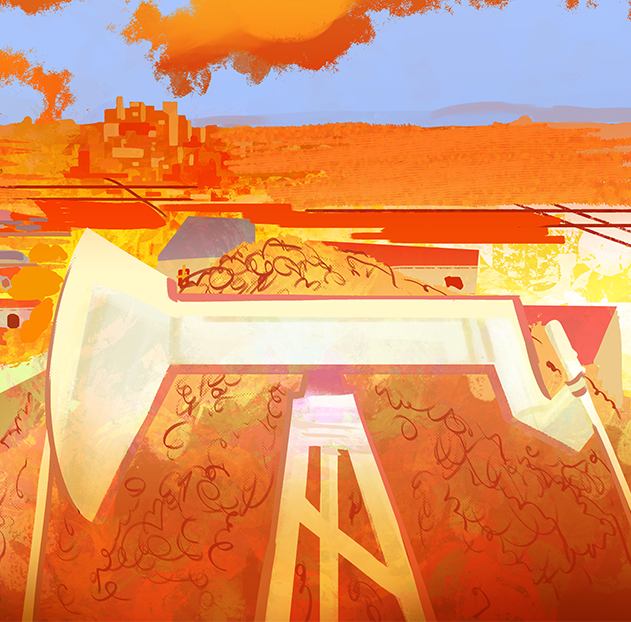
Students analyze an image related to the oil industry, then make observations and generate questions.
Explore
Students work together in small groups to identify characteristics of an economic boom and an economic bust.
Explain
Students read an article about the impact of the oil industry on Oklahoma and discuss topics relevant to the article.
Extend
Students watch a video interview with an oil drilling engineer and complete a graphic organizer.
Evaluate
Students summarize their learning during a short written assessment.
Materials
Lesson Slides (attached)
Card Sort Cards (attached; one set per group)
Oil Booms and Busts article (attached; one per student)
Mirror, Microscope, and Binoculars handout (attached; one per student)
Preparation
10 Minute(s)
Card Sort Preparation
In the Explore phase, students complete a Card Sort activity in small groups. Prior to the lesson, print and cut out one copy of the Card Sort Cards per each small group. Consider printing the cards on heavy paper or cardstock for durability. Place each set of cards in a small plastic bag.
Engage
10 Minute(s)
Use the attached Lesson Slides to guide the lesson. Show slide 2 to introduce the lesson. Move through slides 3–4 to discuss the essential questions and learning objectives.
Display the image on slide 5. Review the I Notice, I Wonder instructional strategy with students. Show slide 6 and invite students to make observations and ask questions about the image using the following prompts:
What do you notice about this image?
What does this image make you wonder?
Encourage students to share out their responses. As they share, record their responses on the board or on chart paper.
Explore
20 Minute(s)
Ask students to find a partner. Distribute one set of the attached Card Sort Cards to each pair of students. Move to slide 7 and review the Card Sort instructional strategy. Ask pairs to read through their set of cards and lay out the three category cards: “Boom,” “Bust,” or “Both.” Ask them to then sort each of the remaining cards into the three categories. Begin the 5-minute timer on the slide.
Once time is up, ask pairs to join with another pair to form groups of four. Have small groups spend another five minutes comparing their Card Sorts and discussing the similarities and differences.
Review the sorted cards as a whole class. Invite volunteers to share out their sorts and the reasoning behind why they sorted them as they did. Discuss which cards were challenging to categorize and why.
Conclude the discussion by sharing the definitions of economic boom and economic bust on slides 8–9.
Explain
25 Minute(s)
Go to slide 10 and place students into pairs. Pass out one copy of the attached Oil Booms and Busts article to each student. Ask students to first read the article individually. Then, ask students to work with their partners to discuss the following topics related to the article:
Examples of economic growth in Oklahoma
Types of job opportunities in Oklahoma created by the Oil Boom
Prosperity of Oklahoma
Communities’ dependence on oil
Environmental concerns
Wealth gaps in Oklahoma
Encourage students to use text evidence to support their claims and ideas.
Start the 10-minute timer and have students begin their discussions.
Extend
20 Minute(s)
Move to slide 11 and have students watch the Petroleum Engineering and Trigonometry ICAP video.
Give each student one copy of the attached Mirror, Microscope, Binoculars handout. Display slide 12 and review the Mirror, Microscope, Binoculars instructional strategy. Ask students to reflect on the ICAP video and respond to the questions on the handout. Allow students time to record their responses.
Evaluate
10 Minute(s)
Display slide 13 and ask students to take out a piece of notebook paper. Review the Two-Minute Paper instructional strategy with students. Present the following prompts to students and ask them to choose one to respond to:
Why do you think boom and bust cycles happen in industries like oil, and how do these economic cycles affect people’s lives and communities?
How does the oil industry create both opportunities and problems for a state like Oklahoma? Give examples of each.
Begin the two-minute timer and allow students to respond to the prompts.
Resources
K20 Center. (n.d.). Card sort. Strategies. https://learn.k20center.ou.edu/strategy/147
K20 Center. (n.d.). I notice, I wonder. Strategies. https://learn.k20center.ou.edu/strategy/180
K20 Center. (n.d.). Mirror, microscope, binoculars. Strategies. https://learn.k20center.ou.edu/strategy/3020
K20 Center. (n.d.). Two-minute paper. Strategies. https://learn.k20center.ou.edu/strategy/152
K20 Center. (2021, September 21). K20 Center 5 minute timer [Video]. YouTube. https://www.youtube.com/watch?v=EVS_yYQoLJg
K20 Center. (2021, September 21). K20 Center 10 minute timer [Video]. YouTube. https://www.youtube.com/watch?v=9gy-1Z2Sa-c
K20 Center. (2021, September 21). K20 Center 2 minute timer [Video]. YouTube. https://www.youtube.com/watch?v=HcEEAnwOt2c
K20 Center. (2023, September 18). K20 ICAP- Petroleum engineering and trigonometry [Video]. YouTube. https://www.youtube.com/watch?v=vNBCiu7Tgns