


Summary
In this series of activities, students delve into the field of forensic entomology by engaging in hands-on activities designed to spark curiosity, deepen understanding, and activate critical thinking skills. Students review the life cycle of flies, assume the roles of forensic investigators, and tackle authentic case students. Throughout these activities, students make real-world connections between the content and the field of forensic entomology, its processes, and how it is applied to solve crimes. These activities are based on the lesson "Crime Solving Insects" and can be used in a forensics class or club.
Essential Question
How do insects aid in forensic investigations?
Learning Objectives
Identify forensic entomology vocabulary.
Understand how environmental conditions affect insect activity and biodiversity.
Determine post-mortem intervals (PMIs) by analyzing insect activity in realistic forensic entomology case studies.
Snapshot
Activity 1
Students activate prior knowledge about forensic entomology and explore the life cycle of flies.
Activity 2
Students review key concepts, complete guided notes, and apply new skills to solve a case study.
Activity 3
Students solve forensic case studies by collecting, analyzing, and interpreting data and evidence.
Activity 4
Students watch a video highlighting a career path related to forensic entomology then synthesize and reflect on information learned in this activity.
Materials List
Activity Slides (attached)
Pen or pencil
Activity 1
ABC Graffiti handout (attached; one per group)
Life Cycle Map handout (attached; one per group)
Life Cycle Cards handout (attached; one set per group)
Forensic Entomology Guided Notes handout (attached; one per student)
Markers (different colors for each group)
Rulers (one per group)
Pipe cleaners
Activity 2
Forensic Entomology Guided Notes handout (attached; continued from previous activity)
Designing the Case Folders document (attached; one copy for teacher)
Case Cards handout (attached; see Designing the Case Folders document)
Case Resources handout (attached; see Designing the Case Folders document)
Detective Notes handout (attached; one per student)
Colored pipe cleaners (at least five different colors)
Plastic bags (one per case)
Manilla envelopes
Scissors
Forceps or tweezers (optional)
Plastic or latex gloves (optional)
Activity 3
Designing the Case Folders document (attached; one copy for teacher)
Case Cards handout (attached; see Designing the Case Folders document)
Case Resources handout (attached; see Designing the Case Folders document)
Activity 4
Reflect and Discuss handout (attached; one per student)
Preparation
Activity 1: Card Sort
Print one copy of the attached Life Cycle Map per small group of students and one copy of the Life Cycle Cards per every two small groups of students. The Life Cycle Cards handout includes two sets of cards; each group needs one set. Optionally, you may choose to laminate the Life Cycle Map and Life Cycle Cards for durability.
Cut multiple pipe cleaners into lengths of 16 mm, 25 mm, 32 mm, and 34 mm. Put some pipe cleaners of each length into one plastic bag per small group of students. Add one set of Life Cycle Cards to each plastic bag.
Activity 2 and Activity 3: Case Stations
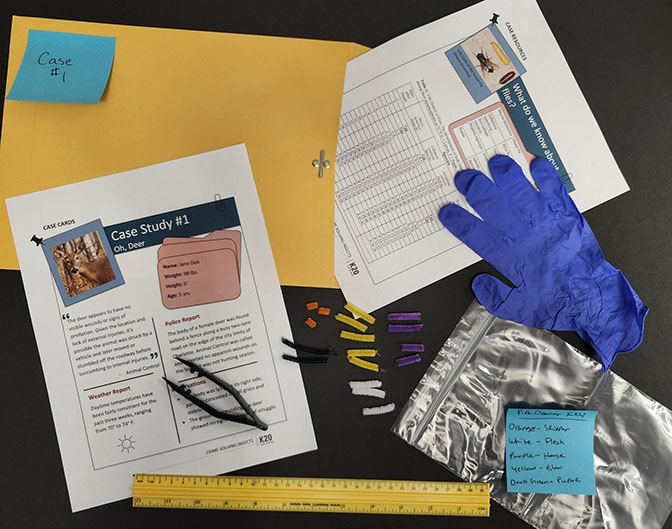
Create case folders for three different stations around the room. Use the attached Designing the Case Folders document and the image below for additional reference.
Print multiple copies of “Case Study 1” from attached Case Cards handout, including one for yourself. Print 1–2 copies of the remaining cases in the handout. Place one copy of each case card into a manilla envelope, and fill the envelope with the other materials outlined in the Designing the Case Folders document.
Organize all of the case folders into three different stations around the room: One station for “Case 2,” one station for “Case 3” and one station for “Case 4.” Each individual station should have multiple case folders all containing the same case.
Activity 1
40 Minute(s)
Use the attached Activity Slides to facilitate this activity. Move to slide 2 and introduce the ABC Graffiti strategy to students. Divide students into small groups and give each group one marker and one of the attached ABC Graffiti handouts.
Explain to students that they should work with their group members to respond to the prompt “What can we learn from bugs?” by filling in as many letters as possible.
Display slide 3 and have students begin writing. Start the 3-minute timer. When time is up, display slide 4. Have students rotate to the next group, briefly read that group’s responses, and resume writing on that ABC Graffiti handout. Start the timer again. Repeat the process once more using slide 5.
Once all rounds are complete, invite volunteers to share the responses on their ABC Graffiti charts.
Transition through slides 6–8 and share the title of the activity, the essential question, and the learning objectives.
Organize students into small groups and give each group one copy of the attached Life Cycle Map, one set of the attached Life Cycle Cards, one set of cut pipe cleaners, and one ruler. Share that students should complete a modified Card Sort to review the bug life cycle. Display slide 9 and ask groups to identify the life cycle stages of a fly by organizing the life cycle stage cards on to the Life Cycle Map. Begin the 2-minute timer on the slide and have students work.
Once time is up, pass out one copy of the attached Forensic Entomology Guided Notes handout to each student. Move to slide 10 and review the correct order of stages on the Life Cycle Map. Clear any misconceptions students may have.
Display slide 11 and share instructions for Round 2 of the Card Sort. Have students retrieve the ruler and the pipe cleaners from their bags. Instruct students to measure the pipe cleaners, which represent the size of a fly at each stage of the life cycle, and place them on the “Size” space next to the corresponding stage of the Life Cycle Map. Remind students that not all spaces will be filled.
Begin the 3-minute timer and have students work. Once time is up, invite volunteers to share out what size the fly should be at each different stage.
Go to slide 12 and have students remove the last set of cards from their bags for Round 3 of the Card Sort. Have them use the information they have gathered so far to infer the duration of each time the fly spends in each stage. Have them indicate their inferences by placing the time duration Life Cycle Cards on the map. Begin the 2-minute timer on the slide.
After time is up, transition through slides 13–15 to review the answers for both Round 2 and Round 3 of the Card Sort. Encourage students to rearrange their Life Cycle Maps as needed and take notes on the Forensic Entomology Guided Notes handout. As you share the information, highlight the fact that adult flies lay their eggs on openings of a carcass because these openings are the easiest points of entry. This fact is important for later activities.
Conclude this activity by collecting all materials and handouts. These will be used during Activity 2.
Activity 2
60 Minute(s)
Begin this activity by reviewing what you did during the previous meeting. Pass back the Forensic Entomology Guided Notes to students.
Transition through slides 16–17 and share what a forensic entomologist does as part of their job. As you share information, have students continue to take notes on the Forensic Entomology Guided Notes handout.
Move to slide 18 and introduce the I Notice, I Wonder strategy. Share that students should watch the video on the next slide and take notes in the chart under the “Video Reflection” section of their handouts. Transition to slide 19 and play the Forensic Entomology video clip.
Display slide 21 and explain how forensic entomologists use insects as evidence. If you begin this activity during a new class session, remind students to take out their Forensic Entomology Guided Notes handout and continue completing it.
Show slide 22 and introduce the Cognitive Comics strategy. Share that students should draw visuals depicting how they understand the stages of body decomposition in the boxes under the “Stages of Decomposition” heading as you share information on the next slides. Encourage students to use an animal or human body as the main image in each box.
Transition through slides 23–26 and describe the stages of decomposition on as much detail as necessary. Review the image of the fly life cycle on the slides, which goes clockwise from eggs, larva, pupa, to adult. After reviewing all content, invite volunteers to share their comic strips with the whole class.
Transition through slides 27–29 and review which insects appear at each decomposition stage. Emphasize how the presence or absence of certain insects helps forensic scientists determine the postmortem interval (PMI). Explain that, for example, when scientists find a hide beetle on a body, they know that flies have already come and gone and the body is in a late stage of decomposition.
Display slide 30 and have students watch Crime Solving Insects with Michael Chism, a video interview with someone who works in the field of forensic entomology.
After students watch the video, move to slide 31 and introduce the educational paths students can take to pursue a career in the field of forensic entomology.
Divide students into small groups and give each group one of the case folders featuring Case 1 from the Case Cards. Give each student one copy of the attached Detective Notes handout.
Display slide 32 and share that you and the whole class will work together to complete Case 1. Have students familiarize themselves with the contents of the case folder, but have them keep the bag of “evidence” sealed. Then, invite students to place everything to the side. Lead a discussion using the three questions on the slide and have students take notes on the Forensic Entomology Guided Notes handout.
Transition through slides 33–34 and discuss insect succession. Draw students attention to the table on slide 33, which outlines the insects that arrive at different states of body decomposition. Highlight that blow flies are often the first to arrive at the corpse, as this is relevant to the case studies. Next, move to slide 35 and have students take the Case Resources handout from the folder. Facilitate a discussion using the questions on the slide.
Transition through slides 36–37 and share other factors that impact a PMI. Remind students to continue to take notes on their handouts as you share each slide. When reviewing slide 37, remind students that both temperature and the presence of drugs will affect the development of fly larvae and increase or decrease the estimated PMI.
Display slide 38 and have students read the Case 1 Case Card from their folders. Have them remove the bags of evidence from the folders and measure it. Allow them time to discuss their evidence and the questions on the slide, then ask volunteers to share out points from their responses to the questions. As students share, answer questions, ask clarifying questions, and clear up any misconceptions. Move to slide 39 to display the correct responses to the questions.
Have students return all materials to their case folders and have them return the folders. Conclude this activity and collect materials for use during the next activity.
Activity 3
60 Minute(s)
Review the previous activities with students. Organize students into small groups and display slide 40. Assign students to one of the stations around the room, and explain that students should solve the case at that station. Stress that they should only rotate to the next station when asked. If needed, unhide slide 41 and provide reminders of things to look for when solving a each case.
Display slide 42. Have students use the provided resources to solve the case at their station as the whole class solved Case 1 earlier. Start the 10-minute timer on the slide.
When time is up, have students rotate to the next station and restart the 10-minute timer. Repeat this process until students have visited every station.
Transition through slides 43–48 to review the correct data for each case. For each case, allow students to share out their responses before presenting the correct data and resolving any misconceptions. When reviewing Case 3, draw students’ attention to the temperature (84–86 °F) and presence of oleandrin when assessing blow fly development. Share that only temperature affects house and flesh flies.
Collect all materials at the end of the activity to be used for future activity meetings.
Activity 4
25 Minute(s)
Begin this activity by reviewing what students have accomplished during the past three activities.
Display slide 49 and introduce the career-focused video Crime Solving Insects with Ashley Meerschaert. Share that this video highlights a career path related to forensic entomology, and this career in forensic science works with skulls and bones. Play the video for students.
Go to slide 50 and distribute the Reflect and Discuss handout. Have students first respond to the questions individually. Then, have them find an Elbow Partner, share their responses, and take notes. Have them adjust their own responses based on any information they gained from their partner. Invite volunteers to share out.
Follow-Up Activities
To follow this activity, consider having students complete another activity from the Forensic Activity Collection.
Research Rationale
Research rationale for this resource is provided in the literature review Career Exploration Through Experiential Learning - Forensics.
Resources
fearlessaggie. (2008, September 26). Forensic entomology [Video]. YouTube. https://www.youtube.com/watch?v=dntO3YANo18
Flinn Scientific. (n.d.). Of maggots and murder: Forensic entomology laboratory kit. https://www.flinnsci.com/of-maggots-and-murder---forensic-entomology-laboratory-kit/ap7028/
K20 Center. (n.d.). ABC graffiti. Strategies. https://learn.k20center.ou.edu/strategy/96
K20 Center. (n.d.). Card sort. Strategies. https://learn.k20center.ou.edu/strategy/147
K20 Center. (n.d.). Cognitive comics. Strategies. https://learn.k20center.ou.edu/strategy/198
K20 Center. (n.d.). Elbow partners. Strategies. https://learn.k20center.ou.edu/strategy/116
K20 Center. (n.d.). Forensic activities collection. Collections. https://learn.k20center.ou.edu/collection/5831
K20 Center. (n.d.). I notice, I wonder. Strategies. https://learn.k20center.ou.edu/strategy/180
K20 Center. (2021, September 21). 2 minute timer [Video]. YouTube. https://www.youtube.com/watch?v=HcEEAnwOt2c
K20 Center. (2021, September 21). 3 minute timer [Video]. YouTube. https://www.youtube.com/watch?v=iISP02KPau0
K20 Center. (2021, September 21). 10 minute timer [Video]. YouTube. https://www.youtube.com/watch?v=9gy-1Z2Sa-c
K20 Center. (2025, February 19). K20 ICAP - Crime solving insects with Ashley Meerschaert [Video]. YouTube. https://www.youtube.com/watch?v=MyJAvzPElW4
K20 Center. (2025, February 19). K20 ICAP - Crime solving insects with Michael Chism [Video]. YouTube. https://www.youtube.com/watch?v=ieiBSQyKEoo
Tynan, P. (2020). Effect of body size on the rate of decomposition in the UK: Measuring total body score and percentage mass change in Sus scrofa. Research Gate. https://doi.org/10.13140/RG.2.2.31227.54561
Wired. (2022, October 21). How entomologists use insects to solve crimes [Video]. YouTube. https://youtu.be/j8PoWlQkduA