

Summary
Students will be able to explain the fundamental concepts involved in electrostatics, such as charge, friction, conservation of charge, laws of attraction, and Coulomb’s Law.
Essential Question(s)
How is static charge generated and how do isolated charges separated by a distance relate to force?
Snapshot
Engage
Students watch a short video of a dog that has been charged and write a 20 word Gist statement to describe the physics of what they see in the video.
Explore
Students develop a method to levitate a ring made of grocery bag material using a balloon and paper towel. Students will write a 50-word Gist statement, explaining what happened using their academic vocabulary.
Explain
Students share Gist statements, and the teacher clarifies and formally defines terms and relationships involved in electrostatics including conservation of charge and Coulomb’s Law.
Extend
Students apply mathematical relationships to electrostatic problem solving and research additional applications of electrostatics.
Evaluate
Students will explain the process of lightning using academic vocabulary from the lesson.
Materials
Lesson Slides (attached)
Practice Problems (attached; one per student)
Teacher Guide Practice Problems (attached; optional)
Career-Focused Reflection (attached; optional)
Grocery bags
Balloons (large, round type works best)
Scissors
Paper towels
Chart Paper
Markers, colored pencils, crayons, etc.
Sticky notes
Engage
10 Minute(s)
Use the attached Lesson Slides to facilitate. Display slide 2 and introduce students to the lesson. Use slides 3-4 to go over the essential question and lesson objectives. Move to slide 5 and introduce students to the I Notice, I Wonder instructional strategy. Play the video on slide 6 and give students time to record their notices and wonders, replay the video if necessary.
Display slide 7. Invite students to share out what they noticed and wondered about the video. Ask students if there were any common words or phrases they heard in each other’s answers. Record those words or phrases on a piece of chart paper or on the board so that they can refer to it as the lesson progresses. Some terms to listen for are static, charge, friction, electrons, negative, positive, attract, repel, electric field, and force.
Explore
30 Minute(s)
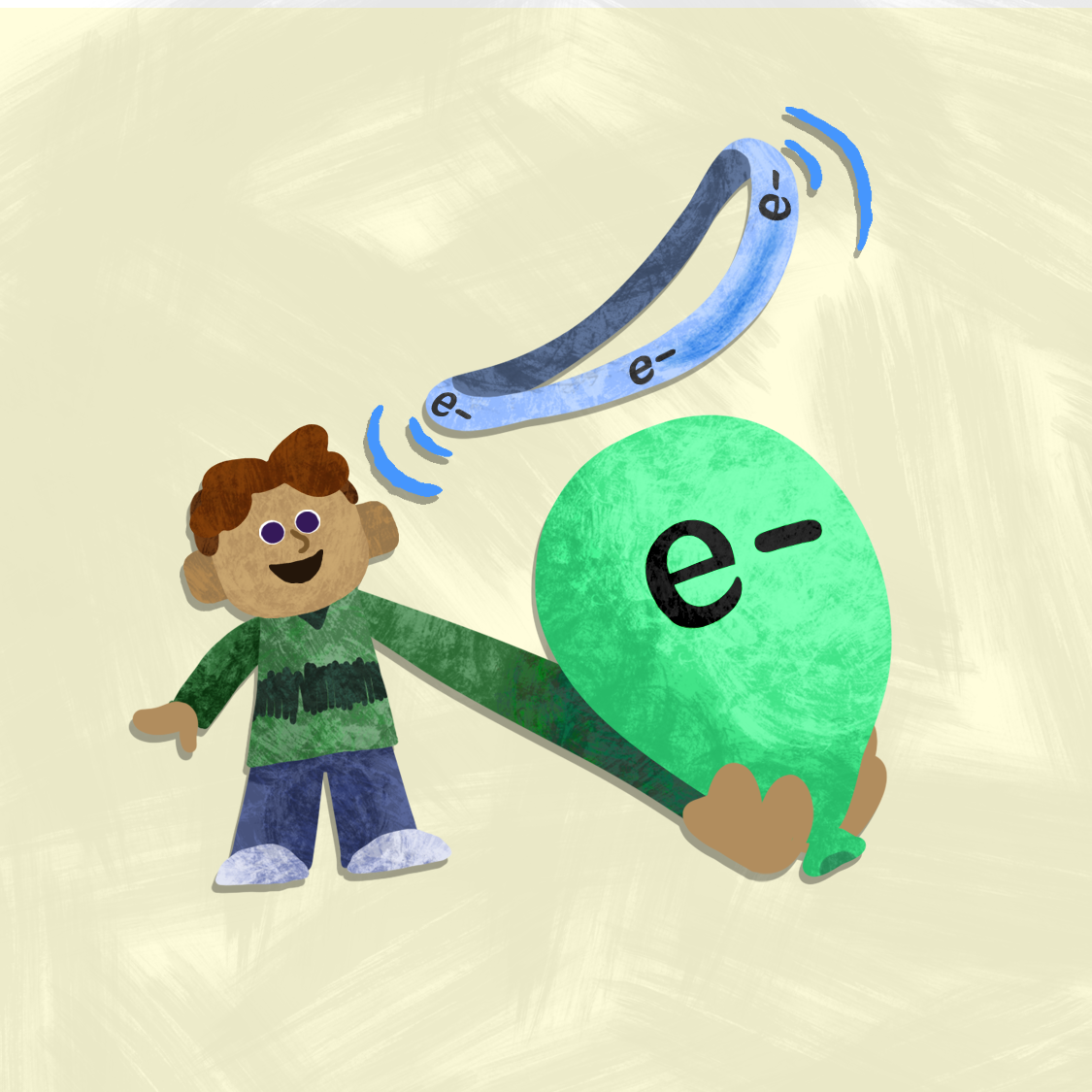
Move to slide 8 and show students the picture of the levitating ring and balloon. Tell students they have 20 minutes to accomplish the same thing they are seeing in the picture, using a balloon to levitate a ring. Go over the list of supplies they will have to complete the task. Avoid the temptation to tell them how to accomplish the task.
Once all of the groups have accomplished the task, display slide 9 and have a class discussion on how the activity was similar and how it was different from the charged static dog video. Use the questions on the slide to guide the discussion and add to the list of terms from the Engage portion. Some additional terms from the discussion may include repel, charge(d), force, and gravity (weight).
Transition to slide 10 after the discussion. Introduce students to the Gist instructional strategy. Have students write a 50-word Gist summary incorporating all of the terms listed and explaining the relationships they observed in the activity or video.
Explain
30 Minute(s)
Move through slides 11–21 to go over the what charge is and how to calculate it.
The laws of attraction state that objects with like charge will repel and charges with opposite charge will attract. Positive and negatives attract while positive-positive or negative-negative interactions will result in repulsion.
Coulomb’s Law states that a mutual force of attraction or repulsion exists between any two charges that is directly proportional to the product of their charges and inversely proportional to the square of the distance between them. This is similar to Newton’s Universal Law of Gravitation.
Fe = (k q1q2)/r^2 where k is a constant = 9 x 10^9 Nm^2/C^2
Move to slide 22 and pass out the Practice Problems handout to each student. Allow students to work with partners as they work through the practice problems. Before they begin, pass out three cups (a red one, a yellow one, and a green one) to each pair. Explain that they should use these cups to communicate how they are doing on the practice problems. Red means they need help, yellow means they are working without trouble, and green means they have completed the practice problems. Have students use this system as they work through the practice problems.
Use to the provided Teacher Guide Practice Problems to support students if they struggle with answering the questions.
Extend
30 Minute(s)
Put students in groups of three or four and pass out a piece of chart paper to each group. Move to slide 23 and explain to students that they will be creating a poster about lightning based on the information they learn. On their poster they will need to include a clear answer, drawings or diagrams, and include applicable vocabulary from the lesson.
Once groups are done with their posters, move to slide 24. Introduce students to the Gallery Walk instructional strategy. Ask students to hang their poster around the room. Inform them that they will be walking around to visit each poster. Explain that to offer feedback, they will be leaving questions on other groups’ posters about the information that could improve their poster.
Evaluate
10 Minute(s)
After all the questions are answered, move to slide 26 and show students the embedded Electroscope Demo ScienceLibrary video. Pause at 0:50. Explain that the device in the video is called an electroscope and it was invented hundreds of years ago to detect charge in objects. The stronger the charge, the greater the reaction of the leaves at the bottom of the device.
Move to slide 27. Use the Think-Pair-Share strategy with this prompt: "Based on what you've learned so far, explain what is happening and why it's happening." Show the video to the students again, stopping again at 0:50. Invite students to give their answers or their partner’s answer to what is happening in the video. Once a few students have answered, play the second half of the video that has the areas of charge labeled.
Resources
Bone, A. (10 Feb. 2013). Electroscope Demo ScienceLibrary.info [Video]. YouTube. https://www.youtube.com/watch?v=Ngv2OlqFWXU
Dwyer, J. (30 Sept. 2005). How Lightning Works. NOVA. https://www.pbs.org/wgbh/nova/article/how-lightning-works/
K20 Center. (n.d.). Gallery walk/carousel. Strategies. https://learn.k20center.ou.edu/strategy/118
K20 Center. (n.d.). Gist. Strategies. https://learn.k20center.ou.edu/strategy/3289
K20 Center. (n.d.). I notice, I wonder. Strategies. https://learn.k20center.ou.edu/strategy/18
K20 Center. (n.d.). Think-pair-share. Strategies. https://learn.k20center.ou.edu/strategy/139
K20 Center. (2026, May 11). Career-focused - climatologist with Monica Maddox. YouTube. https://www.youtube.com/watch?v=Am10w_ksBQg
Rumble Viral. Static Electricity Makes Dog’s Hair Hilariously Stand Up [Video]. YouTube. https://www.youtube.com/watch?v=HXJBi7ZQHIo
The Physics Classroom. (n.d.). Static Electricity - Lesson 3 - Electric Force. The Physics Classroom. https://www.physicsclassroom.com/class/estatics/Lesson-3/Coulomb-s-Law