
Summary
In this lesson, students will compare and contrast analog and digital signals to better understand when and why they are used. Students will build a model representing analog communication and then create a new design for a digital version. By the end of the lesson, students will be able to identify the key traits of each type of signal and how digital signals are more reliable.
Essential Question(s)
How are waves used in communication? Why does modern technology tend to use digital signals rather than analog signals?
Learning Objectives
Identify modern communication devices that use digital signals.
Explain how waves can be used for communication.
Defend the claim that digital signals are more reliable than analog signals.
Snapshot
Engage
Students look at images of different technologies and record what they notice and wonder about the images.
Explore
Students compare analog and digital communication through the game of Telephone and a decoding game.
Explain
Students identify similarities and differences between analog and digital signals.
Extend
Students work in groups to build robot kits, design improved digital versions, and create presentations to justify their design choices.
Evaluate
Students give presentations on their improved design and justify their improvements.
Materials
Lesson Slides (attached)
Thinking About Technology handout (attached; one half page per student; print one-sided)
Binary Decoder (attached; one half page per student; print one-sided)
Binary Cards (attached; one set; print one-sided)
Note Catcher handout (attached; one per student; print two-sided)
New and Improved handout (attached; one per group; print one-sided)
Index cards (one per student)
Doodling Robot Building Kits (one per group)
AA batteries (one per group)
Green plastic cups (one per group)
Yellow plastic cups (one per group)
Red plastic cups (one per group)
Paper
Preparation
Well before this lesson, purchase enough Doodling Robot Building Kits for each group of 4–5 students to have one kit. BeAndge has a 4-pack of these STEM kits available on Amazon. Groups will use these kits during the Extend phase of this lesson to build and operate an analog device that they will later upgrade to a digital device. If this STEM kit becomes unavailable, you can find other analog device kits for students to build through PocketLab or a Snap Circuit kit from companies like Elenco. There is also an alternative activity for this phase of the lesson described below.
Before you begin, print the attached Binary Cards, and then cut out the cards. All of these cards are the same size for easy cutting. Stack the cards in order. The cards are numbered 1–26. Consider using a binder clip to keep the cards for use in the Explore phase.
Engage
10 Minute(s)
Introduce the lesson using the attached Lesson Slides. Display slide 3 and give each student a half-page copy of the attached Thinking About Technology handout. Introduce the I Notice, I Wonder strategy and have students individually write what they notice and what they wonder about the images. If students struggle, prompt them to think about what they see, how the objects work, or why people use them. After a minute, have students turn to an Elbow Partner and discuss what they have written. Have students use this discussion time to add more ideas to their handout. After a couple of minutes, bring the class together and ask for a few volunteers to share what they noticed and what they wondered.
Reveal to the class that they were comparing digital and analog devices. Share that the differences between analog and digital signals are what they are going to learn more about today. Display slide 4 and read the essential questions aloud:
How are waves used in communication?
Why does modern technology tend to use digital signals rather than analog signals?
Display slide 5 to share the lesson objectives. Review these slides with students as needed.
Explore
30 Minute(s)
Display slide 6 and ask students to form a line. Share the guidelines for the Telephone game with students: each student whispers what they heard to the next student in line, and then the last person announces what they heard.
Pull aside the first student in line, preferably in a space like the hallway where you can speak at a normal volume without being overheard, and tell the student the phrase, “Signals are energy.” Then have the student return to their spot in line. Alternatively, write the phrase on a sticky note or index card and show only this student the phrase.
Have students begin the Telephone game. Remind them that they may only say the phrase once. As students whisper the message throughout the telephone line, walk around and interrupt students as they try to pass the message. Intentionally target students who are trying to pass the message with unrelated questions such as, “What did you do this weekend?” or “How did the game go last Friday?”
Some students may catch on that you are trying to interrupt the message intentionally. Acknowledge their observations without confirming the purpose of the interruption, and encourage them to keep passing the message. Once the message reaches the end of the line, have the last student announce the phrase they heard to the whole class.
Display slide 7 and share with students that the original phrase was “Signals are energy.” Invite students to discuss how the phrase they heard differed from the original.
Have students return to their desks and determine the order in which they will pass the Binary Cards. Students will pass each card from the first person in the path to the last person, so each student needs access to a desk or writing surface. Give each student a half-page copy of the attached Binary Decoder handout, an index card, and a writing utensil.
Display slide 8 and preview the Decoding game. Explain that you will use the attached Binary Cards to send students a coded message one card at a time. Begin by giving the first student Card #1. That student will use the Binary Decoder handout to decode the first letter of the message, write the letter on their index card, and pass the Binary Card to the next student in the path. Then, give the first student Card #2 and have them repeat the process while the second student decodes Card #1. Continue this process until students have decoded all 26 cards. As students decode the message throughout the chain, walk around and interrupt students again as they try to pass the Binary Cards. When the whole class agrees on the decoded message, have students announce it.
Display slide 9 and reveal that the coded message was “TECHNOLOGY TRANSFERS SIGNALS.”
Explain
20 Minute(s)
Explain that the Telephone game modeled analog communication because the message changed continuously as it moved from person to person. The binary code modeled digital communication because the message was broken into separate pieces that could be decoded and checked. These activities demonstrate that analog and digital signals are two ways information can be represented and transferred using waves, like the technologies students examined during the I Notice, I Wonder activity.
Display slide 10 and facilitate a whole-class discussion to close the activity:
What was the difference between the two ways of communication?
Which version was more accurate?
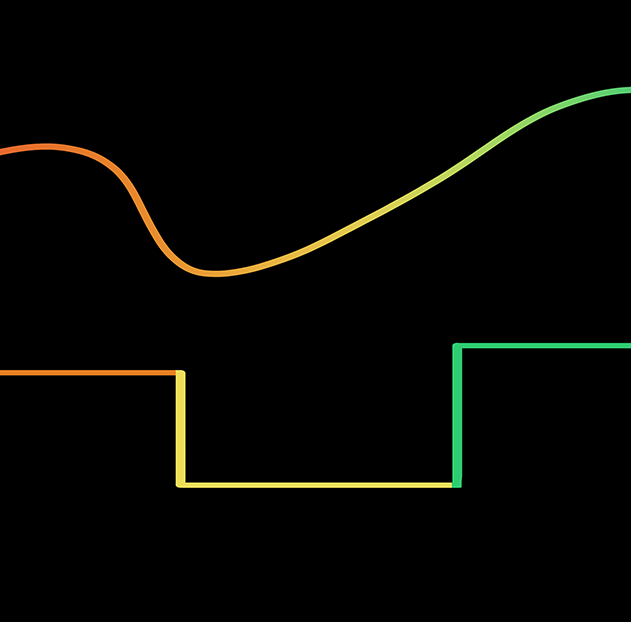
Display slide 11 and give each student a copy of the Note Catcher handout. Use this slide to share the differences between analog and digital waves. Have students sketch the graphs on their handout.
Display slide 12 and share the definitions of Analog and Digital. Have students record these definitions on their handout. Use this slide to also share examples of tools and equipment that primarily use each type of signal. Have students record a few examples of each and share examples that they already know.
Display slide 13 and explain to students that they are about to watch a video comparing analog and digital signals, and that as they watch the video, they should take notes in the Venn diagram on their handout. Let students know that, in addition to information from the video, they should leave space to add information after the video.
Display slide 14 and play the Digital vs. Analog: What’s the Difference? Why Does It Matter? video.
When the video ends, ask for volunteers to share what they recorded in their Venn diagram, then transition through slides 15–16 to share the main differences and similarities. The text in pink is information from the video, while the text in black is new information; encourage students to record this new information in their Venn diagram.
Extend
80 Minute(s)
Display slide 17 and have students get into groups of 4–5 or assign groups. These groups are going to build robots and continue working together for the remainder of the lesson. Give each group a Doodling Robot Building Kit, one AA battery, three cups (one green, one yellow, and one red), and blank paper.
Have students work together to build a robot. Explain that the robot serves as a model of an analog device because its movement creates a continuous, physical output. Have groups use the cups to quickly communicate their progress: red means they need help, yellow means they are working without trouble, and green means they are done building. Give groups approximately 20–25 minutes to build and test their robots.
When a group is finished, review the build and functionality of their robot. After approval, have students gently take apart their robot (so another class can use it). Then show slide 18 and give each group a copy of the attached New and Improved handout. Explain to students that their group now needs to design a new and improved robot and create a short presentation about their improved design. Use the handout to review the expectations such as what to include in the presentation, the requirements for the CER slide—where they use the Claim, Evidence, Reasoning strategy—and considerations for making a well-designed presentation.
Evaluate
70 Minute(s)
Once groups have finished their presentations, display slide 23 and set presentation norms with the class: audience members are to be respectful and take notes to be prepared for a brief Q&A session after the presentation.
After each presentation, give the audience time to ask a couple of questions.
Use each group’s CER slide as a formative assessment.
Resources
Amazon. (n.d.). BeAndge STEM Kits: 4-pack: Doodling robot building kits. https://a.co/d/0bXTFbwm
Basics Explained. (2021, September 10). Digital vs. Analog. What’s the difference? Why does it matter? [Video]. YouTube. https://www.youtube.com/watch?v=ZWdT-6Ld71Q
Elenco Electronics, LLC. (n.d.). Snap Circuits. Elenco. https://elenco.com/
K20 Center. (n.d.). Claim, evidence, reasoning (CER). Strategies. https://learn.k20center.ou.edu/strategy/156
K20 Center. (n.d.). Elbow partners. Strategies. https://learn.k20center.ou.edu/strategy/116
K20 Center. (n.d.). I notice, I wonder. Strategies. https://learn.k20center.ou.edu/strategy/180
K20 Center. (2021, May 10). Director of medical imaging for community health centers, inc. [Video]. YouTube. https://www.youtube.com/watch?v=7kW5Lb89nqU
PocketLab. (2026, March 18). Science. Everywhere. PocketLab. https://www.thepocketlab.com/