

Summary
Students examine the policies of Andrew Jackson related to Native Americans by studying a political cartoon, deconstructing the idea of paternalism, and exploring primary sources from Andrew Jackson and tribal leaders. They will summarize their learning using a POMS reflection.
Essential Question(s)
How did Andrew Jackson address issues related to Native Americans during his presidency? How did Native Americans respond to Andrew Jackson’s actions?
Learning Objectives
Develop an understanding of the policies of Andrew Jackson related to Native Americans.
Examine the responses of Native leaders to Jackson’s policies.
Snapshot
Engage
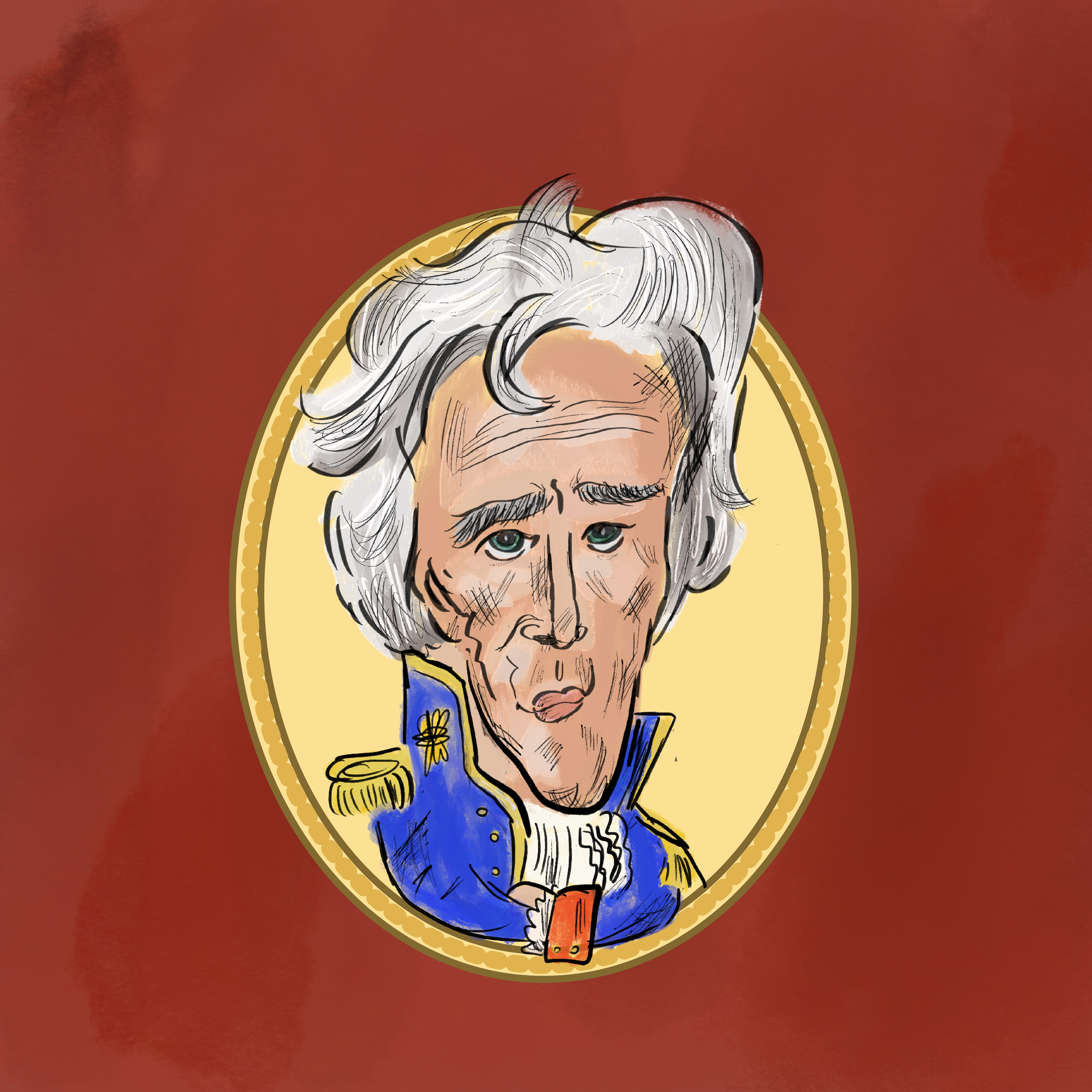
Students will analyze a political cartoon depicting Andrew Jackson and his policies concerning Native tribes using the I Notice, I Wonder strategy.
Explore
Students will complete a Frayer model to examine the term paternalism.
Explain
Students will review their understanding about this era by watching a contextual video about Andrew Jackson’s presidency.
Extend
Students will annotate and compare primary sources from Andrew Jackson and Native American leaders using Stop and Jot and Paired Texts H-Chart strategies.
Evaluate
Students will complete the lesson using the POMS strategy to identify the most significant information from the lesson.
Evaluate 2 (optional)
Students develop a political cartoon from the Native American perspective that counters the initial cartoon viewed in the Engage phase of the lesson.
Materials
Lesson Slides (attached)
Reflections on Paternalism handout (attached; one per student)
Jackson and Chickasaw Delegation handout (attached; one per student, see Preparation Note)
Speckled Snake Response handout (attached; one per student, see Preparation Note)
Paired Text H-Chart handout (attached; one per student)
Chickasaw Response handout (attached; optional)
Jackson and Cherokees handout (attached; optional)
Jackson and Congress handout (attached; optional)
Jackson and Indian Removal handout (attached; optional)
Osceola Response handout (attached; optional)
Cognitive Comics handout (attached; optional)
Paper
Internet access
Pen/Pencil
Index cards or sticky notes
Preparation
For the Engage, prepare a space for recording student responses to the I Notice, I Wonder activity. Also, determine the number of handouts for both Jackson and Chickasaw Delegation and Speckled Snake Response, based on the size of the groups you expect to use.
Note on Sensitive Content
This lesson addresses the Indian Removal Act and the effects of Andrew Jackson's policies on Native American nations. Discussions may include historical trauma, forced migration, land dispossession, and unequal treatment of indigenous peoples. Teachers are encouraged to establish respectful classroom discussion norms and may wish to use the Food Fight: Difficult Conversations lesson to help students navigate challenging conversations and perspectives related to these and other historical events.
This lesson contains expressions and themes which may be considered outdated. However, these elements have been included without alteration to preserve the historical context. Teacher discretion is advised.
Engage
15 Minute(s)
Use the attached Lesson Slides to guide the lesson. Introduce the lesson with the title on slide 2. Transition to slide 3 and read aloud the essential questions. Show slide 4 with the lesson objectives and explain that the lesson will develop an understanding of the policies of Andrew Jackson as related to Native Americans and examine the responses of Native leaders to Jackson’s policies.
Display slide 5 and explain the I Notice, I Wonder instructions for viewing the political cartoon of Andrew Jackson. Explain that they should jot down "notices" (true statements) and "wonderings" (questions they have) about what they see. Transition to slide 6 and allow students time to view the image as you pass out the Reflections on Paternalism handout to each student. After students have had time to reflect individually, invite them to share their thoughts with an Elbow Partner. After a few minutes, facilitate a class discussion. As they share out, record a list of "notices" and a list of "wonderings" somewhere that is visible to all students.
Explore
20 Minute(s)
Have students flip over their “Reflections on Paternalism” handout and review the instructions for completing the Frayer Model on slide 7. Have students write the term “paternalism” in the center oval of the graphic organizer. If students have not used Frayer models before, demonstrate how to complete the Frayer model by using a familiar concept. Give students time to fill in the diagram. Once the diagram is complete, let students share their ideas with a partner or group, modifying their diagrams as they accept new information. Students can share out their thoughts, if time allows.
Explain
10 Minute(s)
Show the Andrew Jackson Biography video on slide 9. Prior to viewing, instruct the students that this biography is an overview of Jackson’s presidency; they should look for how Native Americans fit into the bigger picture of Jackson’s term in office.
Play the video: Andrew Jackson: 7th President of the United States | Biography.
After viewing the video, invite students to return to their “Reflections on Paternalism” handout and add anything new that they learned. Consider asking the following guiding questions: How does this fit with what you already know about Andrew Jackson's presidency? What new information did you learn about Andrew Jackson's presidency?
Extend
30 Minute(s)
Divide the room in half and then create pairs within each half. Distribute the Jackson and Chickasaw Delegation handout to one half of the room and the Speckled Snake Speech handout to the other half. Explain the rules of the Stop and Jot strategy listed on slide 10. Have students read the text, making notes in the margins after each paragraph as they go. Remind students to think about their “notices” and “wonderings” as they read. Allow students time to read. After time is called, have each pair discuss the notes they wrote in the margin. Once they have a final consensus on their understanding of the document, pass out the Paired Texts H-Chart handout to every student (or have them create it on a sheet of paper) and move to slide 11.
Instruct students to record their information within the appropriate column of the Paired Texts H-Chart. Have students partner with another pair from the other side of the room so that both documents are represented within the group. Once groups are established, move to slide 12 and have students discuss and record their notes, ensuring that their groupmates have a thorough understanding of all the material in the text. They can record information from the second source on the other leg of the H-chart.
When you notice groups finishing, transition to slide 13. Explain that as a group, they can then synthesize information from both sources and record it in the middle section of the chart. Depending on time, consider having a group discussion about what students learned from putting the two texts together.
Evaluate
10 Minute(s)
Pass out sticky notes or index cards to each student. Move to slide 14 and review the instructions for the Points of Most Significance (POMS) strategy. Ask students to think about the most significant point of the lesson. You can do this by starting with a review of the topic and then posing the question, “What connections might there be between the idea of paternalism and the policies of Andrew Jackson? ” Have them write it down on an index card or sticky note. Collect student responses. Let students know how you and they will use the information to move forward as you continue to study westward expansion.
Evaluate 2 (optional)
20 Minute(s)
Unhide slide 15 and have students use the Cognitive Comics strategy to demonstrate their understanding of Jackson’s policies and Native American responses to those policies. Supply each student or group with a Cognitive Comics handout. Students will use the template to construct a response to the opening Jackson cartoon from the Native American perspective using artwork and dialogue bubbles. Students can use as much or as little art as they desire in their comic strip. Comic strips can then be shared with the class and/or turned in for assessment.
Resources
Biography. (2018, May 7). Andrew Jackson: 7th President of the United States | Biography. YouTube. https://youtu.be/X2AHvAJktAg
Colbert, L., Emmubbia, Ash-Tak-Ma-Tut-Ka, McClish, J., & Colbert, M. (n.d.). [Response to government treaty negotiators] [Manuscript]. The Avalon Project. https://avalon.law.yale.edu/19th_century/nt007.asp (Original work written October 24, 1826)
Colbert, L., Emmubbia, Ash-Tak-Ma-Tut-Ka, McClish, J., & Colbert, M. (n.d.). [Further response to government treaty negotiators] [Manuscript]. The Avalon Project. https://avalon.law.yale.edu/19th_century/nt007.asp (Original work written October 27, 1826)
Jackson, A. (n.d.). Andrew Jackson’s annual message [Speech transcript]. National Archives. https://www.archives.gov/milestone-documents/jacksons-message-to-congress-on-indian-removal (Original work published 1830)
Jackson, A. (n.d.). First annual message to Congress [Speech transcript]. University of Virginia Miller Center. https://millercenter.org/the-presidency/presidential-speeches/december-8-1829-first-annual-message-congress (Original work published 1829)
Jackson, A. (n.d.). Talk of the President of the United States [Speech transcript]. Cherokee Phoenix. https://www.wcu.edu/library/DigitalCollections/CherokeePhoenix/Vol3/no20/talk-of-the-president-of-the-united-states-page-4-column-1a-4a.html (Original work published 1830).
Jackson, A. (n.d.). To the Cherokee Tribe of Indians [Open letter]. Teach U.S. History. https://www.teachushistory.org/indian-removal/resources/cherokee-tribe-indians-jackson (Original work published 1835)
K20 Center. (n.d.). Cognitive comics. Strategies. https://learn.k20center.ou.edu/strategy/198
K20 Center. (n.d.). Food fight. Lesson. https://learn.k20center.ou.edu/lesson/1761
K20 Center. (n.d.). Frayer model. Strategies. https://learn.k20center.ou.edu/strategy/126
K20 Center. (n.d.). I notice, I wonder. Strategies. https://learn.k20center.ou.edu/strategy/180
K20 Center. (n.d.). Poms: Point of most significance. Strategies. https://learn.k20center.ou.edu/strategy/101
K20 Center. (n.d.). Stop and jot. Strategies. https://learn.k20center.ou.edu/strategy/168
Osceola. (2009). [Response to Agent Wiley Thompson] [Speech transcript]. In J. Missall & M. L. Missall (Eds.), In Their Own Words: Selected Seminole “Talks” 1817-1842 (Vol. 1, p. 14). The Seminole Wars Foundation. https://seminolewars.org/wp-content/uploads/2018/05/In-Their-Own-Words.pdf (Original work transcribed October 23, 1834).
Snake, S. (1973). Response to Andrew Jackson [Speech transcript]. The American Poetry Review, 2(2), p. 43. https://www.jstor.org/stable/27774562?seq=2
University of Michigan, Clements Library. (n.d.). Indians of the Midwest: Andrew Jackson, the great father, ca. 1830. Newberry Dis. https://digcoll.newberry.org/indians-midwest/media/andrew-jackson-the-great-father-ca-1830
Copilot was used to help write the “Note on Sensitive Content” message. All other content and ideas for this lesson were original to developers.