

Summary
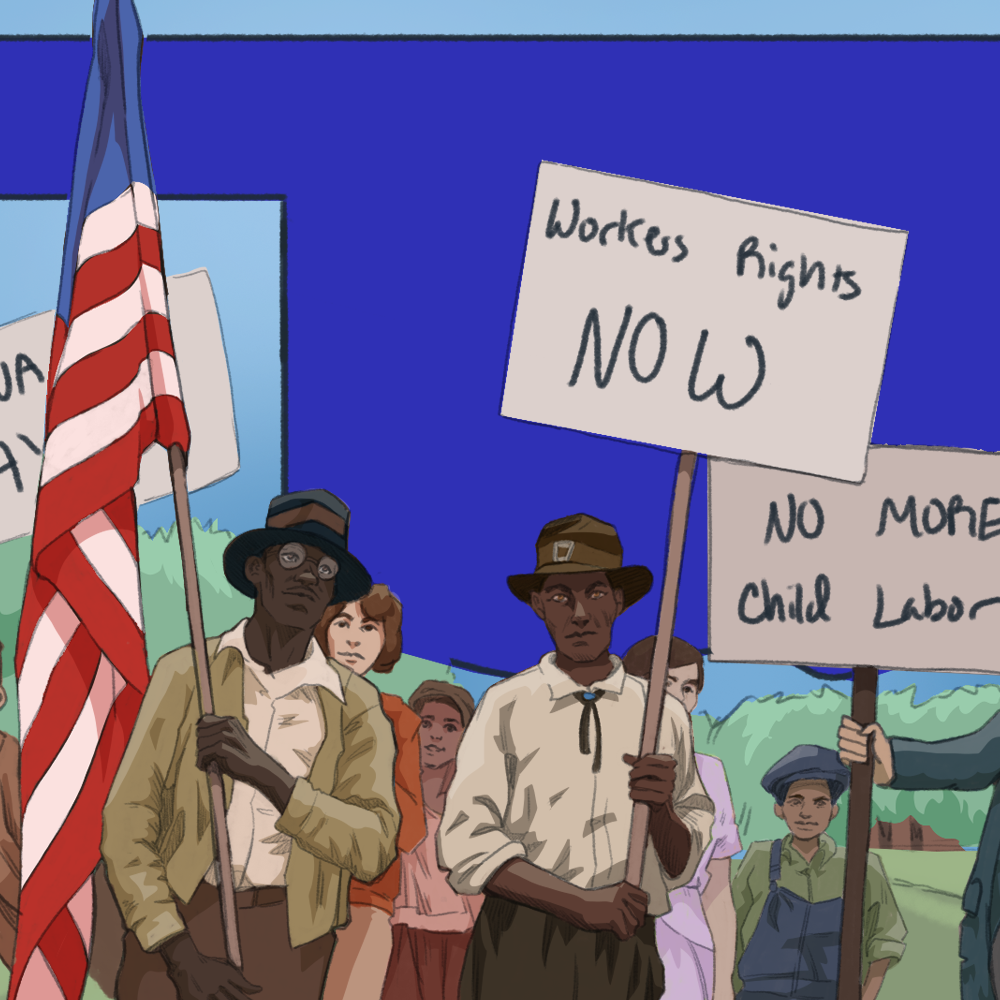
In this lesson, students analyze primary sources to explain how the progressive and labor movements influenced Oklahoma’s state constitution. Learning is extended by viewing an interview with the former president of Oklahoma State AFL-CIO. Students are evaluated by creating their point of most significance from the lesson.
Essential Question(s)
How do citizens, individually or collectively, influence government structure and policy? Should governments regulate businesses to protect the rights of workers?
Snapshot
Engage
Students read "The Shawnee Demands," a primary source, and make a prediction about what the demands have in common.
Explore
In groups, students read and analyze "The Progressive Era in Oklahoma" using the Window Notes strategy.
Explain
Students return to "The Shawnee Demands" and explain how specific demands represent the broader values and goals of the progressive and labor movements.
Extend
Students watch a video interview with the president of the Oklahoma AFL-CIO and identify the Point of Most Significance from the video to discuss.
Evaluate
Students reflect on their learning by writing their Point of Most Significance from the lesson.
Materials
Lesson Slides (attached)
The Shawnee Demands handout (attached; one per student)
Progressive Era in Oklahoma handout (attached; one per student)
Window Notes handout (attached; one per student)
Progressive Influence on Oklahoma's Constitution handout (attached; one per student)
Progressive Influence on Oklahoma’s Constitution Teacher’s Guide document (attached)
Window Notes Teacher’s Guide document (attached)
Engage
15 Minute(s)
Use the attached Lesson Slides to guide the lesson beginning with slide 3. Pass out the attached The Shawnee Demands handout to each student and place students into small groups of 3–4. Tell students the handout is a primary source document from 1906 and is related to Oklahoma history. Do not give students further context for the handout.
Have students read through the document and then discuss in their groups what the list of demands on the document might have in common. Provide time for groups to discuss, then call on each group to share what they discussed.
After each group has shared, display slide 4. Tell students that, as they move forward with the lesson, they are going to explore the context in which The Shawnee Demands were written and explore why citizens advocated for structuring the state government to protect the rights of workers and place more power directly with the people. Ask students to think about the essential questions on slide 4, then move to slide 5 to review the lesson’s learning objectives with students.
Explore
20 Minute(s)
Display slide 6. Pass out the attached Progressive Era in Oklahoma and Window Notes handouts to each student. Review the four prompts in the Window Notes handout and tell students to keep the prompts in mind as they read.
Provide time for students to read through the Progressive Era in Oklahoma handout with their group and fill in the Window Notes handout as they read.
After students have completed filling in the Window Notes handout, call on different groups to share their answers for the four prompts on the handout. As student groups share, take time to clarify, and add any missing information. See the attached Window Notes Teacher's Guide for sample student answers.
Explain
35 Minute(s)
Display slide 7 and pass out the attached Progressive Influence on Oklahoma's Constitution handout. Direct students back to The Shawnee Demands handout and emphasize that The Shawnee Demands was the document written by representatives from the major labor unions in a successful effort to influence the structure of Oklahoma's constitution.
Provide time for groups to relate the information in the Progressive Influence on Oklahoma’s Constitution handout to the Shawnee Demands handout. Consider modeling the first provision with the class before having students work in their groups. See the attached Progressive Influence on Oklahoma’s Constitution Teacher’s Guide for sample student answers.
Once students have finished, ask each group to choose one of their responses to share with the whole class. As student groups share, be sure to correct, clarify, and add any missing information.
Extend
Move to slide 8 and tell students they will listen to the Oklahoma State AFL-CIO President, Jimmy Curry. AFL–CIO stands for the American Federation of Labor and Congress of Industrial Organizations. Explain to students that, in the video, Mr. Curry discusses the creation of Oklahoma's labor unions during the Progressive Era, the general influence of labor organizations, and how labor organizations have worked throughout history to protect workers and limit the power of large corporations. Play the video ICAP - Progressivism, Organized Labor, Oklahoma Constitution.
Display slide 9 and tell students to talk to an Elbow Partner about the questions on the slide in which students reflect on why Mr. Curry said the AFL-CIO is important and how the AFL-CIO relates to the Progressive Era and what was included in the Oklahoma Constitution. Ask for a few volunteers to share.
Evaluate
15 Minute(s)
Display slide 10 and introduce students to the POMS: Point of Most Significance strategy. On the back of a handout have students reply to the question on the slide, what part of the lesson helped you to understand the way in which Oklahoma’s state constitution was influenced by the progressive and labor movement? Provide time for students to write their responses.
Collect the handouts to review and check for student understanding of the lesson content.
Resources
AFL-CIO. (n.d.). Oklahoma State AFL-CIO. https://unionhall.aflcio.org/oklahoma-state-afl-cio
K20 Center. (n.d.). Elbow partners. Strategies. https://learn.k20center.ou.edu/strategy/116
K20 Center. (n.d.). POMS: point of most significance. Strategies. https://learn.k20center.ou.edu/strategy/101
K20 Center. (n.d.). Window notes. Strategies. https://learn.k20center.ou.edu/strategy/189
K20 Center. (2020, April 8). Progressivism, organized labor, Oklahoma constitution. YouTube. https://youtu.be/-klPc1uryrk
Oklahoma Historical Society. (n.d.). The encyclopedia of Oklahoma history and culture. https://www.okhistory.org/publications/enc/entry.php?entry=SH017
Oklahoma State AFL. CIO. (n.d.). https://unionhall.aflcio.org/oklahoma-state-afl-cio