
Summary
Students will model Mendel’s Law of Segregation and Independent Assortment using Popsicle sticks to represent diploid autosomes and sex chromosomes. By the end of this lesson, students will produce unique paper baby dragons. Students should have prior knowledge with the terms basic genetics and completing Punnett squares.
Essential Question(s)
What makes individuals unique?
Snapshot
Engage
Students watch a video or look at a picture and identify all of the similarities and differences of dragons.
Explore
Students explore the Laws of Segregation and Independent Assortment of genes through an activity called Dragon Delivery.
Explain
Students construct an anchor chart about Law of Segregation, Law of Independent Assortment, Incomplete Dominance, and Codominance.
Extend
Students use the parent dragons genotypes to create a baby dragon and create a poster to display the phenotypes.
Evaluate
Students use their knowledge of genes to determine if scenarios can happen and support their answer with evidence.
Materials
Lesson Slides (attached)
Decoding the Dragon (attached; one per student; print two-sided)
Dragon Code (attached; class set)
Dragon CER (attached; one per group of four)
Large craft sticks
Permanent markers (black, green, red, orange, yellow, purple, and blue; see preparation section)
Chart paper
Highlighters
Colored pencils, crayons, or markers
Preparation
Prior to the lesson, create the popsicle sticks with the grandparent genes on them. Materials you will need:
12 large wooden craft sticks per group
Permanent markers to write on the craft sticks (black, green, red, orange, yellow, purple, and blue)
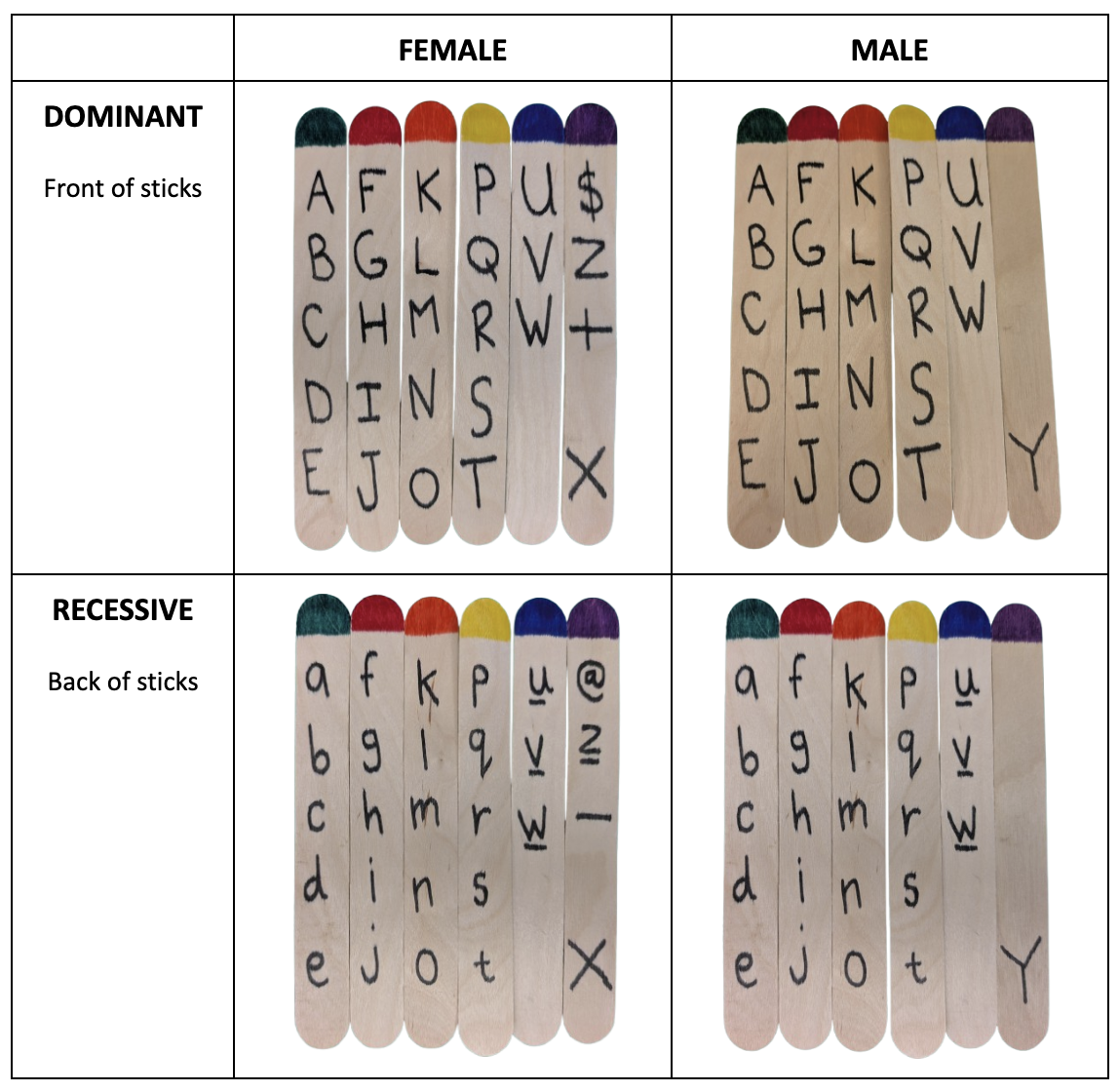
Choose what kind of genetic variation you want the grandparents to be: homozygous (same alleles on both sides) or heterozygous (different alleles on both sides). Each popsicle stick will represent a chromosome, you will write one set of alleles on one side of the stick and the corresponding set on the other side. The options for the chromosomes are below.
Green Autosome: A B C D E -or- a b c d e
Red Autosome: F G H I J -or- f g h i j
Orange Autosome: K L M N O -or- k l m n o
Yellow Autosome: P Q R S T -or- p q r s t
Blue Autosome: U V W -or- u v w
X or Y Chromosome: $ Z + X -or- @ z – X -or- Y
When making the chromosomes consider using the black marker to write the letters and symbols and the colors to differentiate the chromosomes. Place a line under the lowercase letters that are indistinguishable from uppercase. See the image below for an example of grandparent craft sticks.
Engage
10 Minute(s)
Use the attached Lesson Slides to facilitate instruction. Display slide 2 and introduce the lesson title and topic. Use slides 3–4 to go over the essential question and the lesson objectives. Move to slide 5 and instruct students to write down the similarities and differences of the different dragons from How To Train Your Dragon. Go to the All Dragons page on the DreamWorks website. Show the students different dragons as they write down the similarities and differences. You can select specific dragons if the students want a closer look.
Invite a few students to share their responses of similarities and differences. Their responses will be describing phenotypes of dragons. Try to elicit this term through questioning. A sample question might be: What is the term we use when describing these physical traits?
Explore
15 Minute(s)
Move to slide 6 and introduce students to the activity by telling them that they will be surrogate dragon parents. However, before they do that, they will use the grandparents’ genotypes to determine the parents’ genotypes.
Pass out a copy of the Decoding the Dragon handout to each student. Have students pair up to prepare for the activity. Move to slide 7. Provide each pair a set of female chromosomes and a set of male chromosomes (12 sticks total per group as prepared in Preparation section). Instruct the students to lightly toss the stick in the air and onto the table to randomize the alleles from each chromosome. Once every group has tossed, move to slide 8. Tell students to match up the letters and colors on the sticks to make the genotypes for the parents. Remind students that XX is female and XY is male and that they should make sure that they are writing the genotypes in the correct column. Explain that to get the genotype of the other parent they will need to repeat the process they just did.
Explain
25 Minute(s)
Pass out pieces of chart paper to pairs of students. Move to slide 9 and introduce students to the Anchor Chart instructional strategy. Instruct students to divide their chart into four quarters and label each section: Law of Segregation, Law of Independent Assortment, Incomplete Dominance, and Codominance. Move to slide 10 and explain that they will read each of the texts that are linked on the slide.
Law of Segregation: k20.ou.edu/x9
Law of Independent Assortment: k20.ou.edu/xa
Incomplete Dominance & Codominace: k20.ou.edu/xb
As they read, they should summarize the information in the corresponding section. They should add images, symbols, and color to help represent each concept.
When each pair has finished, invite a few pairs to share out what they summarized and the images they used. Facilitate a whole group discussion about the readings to make sure all students have an understanding of the concepts. Select one anchor chart from each class to hang up in the classroom or in the hallway.
Extend
30 Minute(s)
Display slide 11 and pass out 12 blank craft sticks to each pair. Explain to students that they will be writing in each parent's genotypes on the craft sticks. Six sticks will be for the mother, and six sticks will be for the father.
Transition to slide 12 and explain to students that they will be repeating the process they did to find the parents’ genotypes to find the baby dragon’s. Explain to students that they will toss the craft sticks, and when they land, they will fill out alleles from the egg (mother/female) and the alleles from the sperm (father/male). Remind students that alleles mean only one letter is present not both.
Move to slide 13. Have students combine the alleles from the egg and sperm to make genotypes in the “Baby Dragon” column. Pass out a code of the Dragon Code to each pair. Remind students that each genotype has a phenotype-physical characteristic-connected to it. Now that students have their genotypes, ask them to use the Dragon Code to determine the phenotypes.
Display slide 14. Provide students with a poster-sized paper and ask students to create a poster of their baby dragon with the genotypes displayed. Hang the posters around the room.
Evaluate
15 Minute(s)
Move to slide 15 and introduce students to Claim, Evidence, Reasoning (CER) strategy. Pass out the Dragon CER handout and the Dragon Code to each student. Explain they all have a scenario and question on their paper that they will use their notes and what they learned during the activity to answer—this is their claim. Explain that they will need to provide evidence and reasoning to support their claim. Have students share their CER with an elbow partner. After they have shared their responses, provide them time to make edits to their CER if necessary.
Resources
DreamWorks. (n.d.). Explore dragons and Vikings: All dragons. DreamWorks. https://www.dreamworks.com/how-to-train-your-dragon/explore
K20 Center. (2021, August 19). Claims, evidence, and reasoning [Video]. YouTube. https://www.youtube.com/watch?v=JGOxVIgmGWE
K20 Center. (n.d.). Claim, evidence, reasoning (CER). Strategies. https://learn.k20center.ou.edu/strategy/156
K20 Center. (n.d.). Why-lighting. Strategies. https://learn.k20center.ou.edu/strategy/128