

Summary
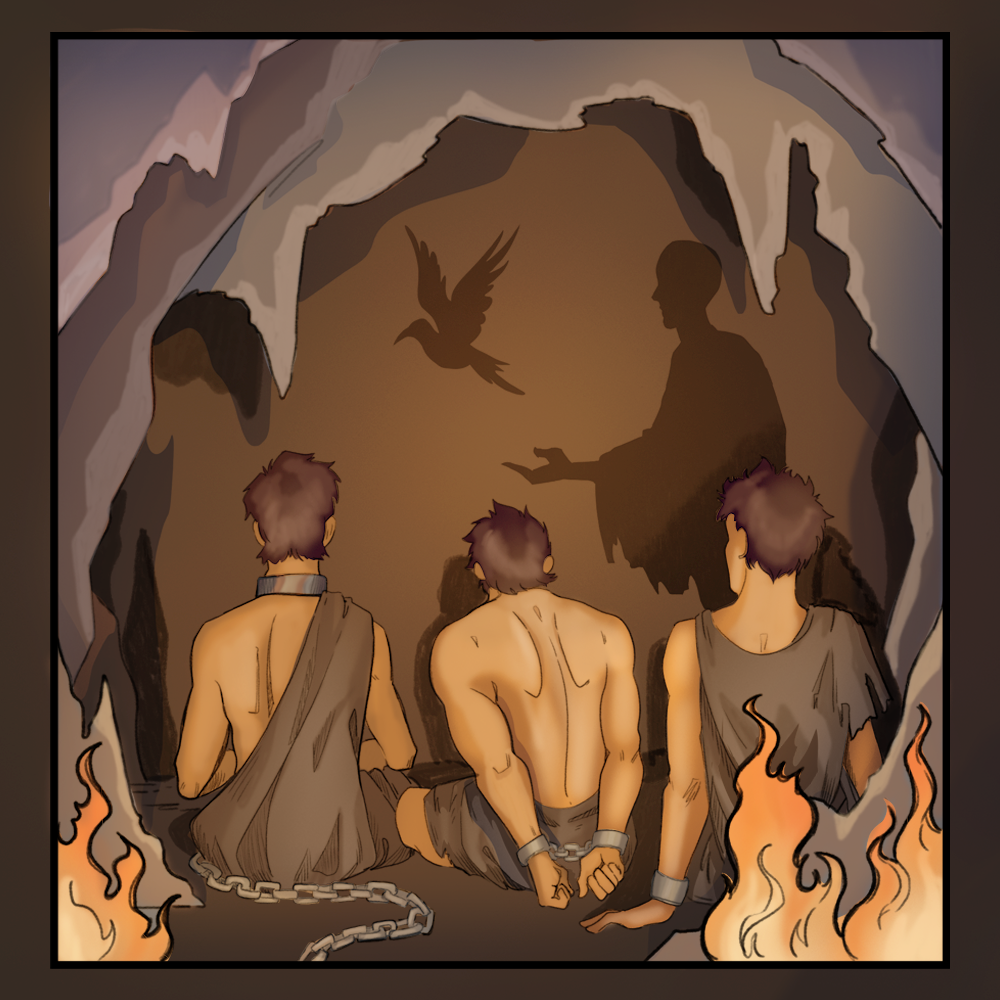
In this lesson, students will explore and identify symbolism in “Plato’s Allegory of the Cave.” They will then create a storyboard to tell their own allegory with symbols that convey a deeper meaning. This lesson can be taught on its own or serve as a pre-reading activity to prepare students for reading texts with meaningful symbolism, such as “Lord of the Flies” or “Animal Farm.”
Essential Question(s)
How can a fictional story tell a deeper truth about the real world?
Learning Objectives
Identify and interpret symbolism.
Demonstrate how allegories convey deeper meaning.
Snapshot
Engage
Partners use the Silent Discussion strategy to interpret a painting together.
Explore
Students investigate the idea of stories having deeper meaning by watching a video about Plato’s Allegory of the Cave.
Explain
Students formalize their understanding of symbolism and allegories, then identify symbolism used in Plato’s Allegory of the Cave.
Extend
Students create their own allegory that is told through a storyboard.
Evaluate
Students identify the components of their allegory and justify how these components combine to create the theme.
Materials
Lesson Slides (attached)
CommonLit account (for teacher use)
Shared Graphic Organizer handout (attached; one per pair; print one-sided)
“The Blinding Sun: An Introduction to Allegory” short story (linked; one per student; print two-sided)
Allegory Tracker handout (attached; one per student; print one-sided)
Allegorical Storyboard Preparation handout (attached; one per student; print two-sided)
Storyboard handout (attached; one per student; print one-sided)
Highlighters (one per student)
Coloring utensils (optional)
Preparation
Before beginning this lesson, you will need to print copies of the “The Blinding Sun: An Introduction to Allegory” short story for students to read during the Explain phase of the lesson. To access the story, go to CommonLit.org and log in or sign up for a free account. Then select “The Blinding Sun: An Introduction to Allegory” by Thomas Pool. Lastly, select “Download PDF” and follow the directions to print this short story for your students. Notice that the PDF contains pages with the story text followed by pages of questions for students. For this lesson, students will only need the story.
For students whose first language is not English, CommonLit.org can provide translations. You must first create a CommonLit.org class in order for them to have access to a translated version of the story. The CommonLit tech tool can assist you with this. Once you have created a class, you can make the class code available to students who wish to read it in Spanish.
Engage
15 Minute(s)
To begin, use slide 3 of the attached Lesson Slides to introduce the essential question. Then move to slide 4 to introduce the learning objectives.
Display slide 5 and introduce the Silent Discussion strategy. Arrange students into pairs and give each pair a copy of the attached Shared Graphic Organizer handout. All groups should be able to see the presentation clearly, and each pair just needs one writing utensil to share. Explain to students that for the Silent Discussion nobody speaks; instead, they are to communicate using words or sketches on their handout. Students should take turns using the writing utensil to add to the handout to create a back and forth of ideas like a normal conversation.
Show slide 6 and direct students’ attention to the first column of their handout: “Step 1.” Have students label this column “See?” as shown on the slide. Explain to pairs that on the next slide they will see a painting and that in this column they are to record all of the details they notice in the painting. Once groups are ready, move to slide 7 and start the 2-minute timer.
Once the timer expires, move to slide 8 and direct students’ attention to the second column of their handout: “Step 2.” Have students label this column “Meaning?” as shown on the slide. Explain to pairs that they are to silently work together to answer the question, “What is the meaning behind this painting?” Explain that there is no one correct answer, but groups should come up with ideas based on what they observed. Move to slide 9, which shows The Persistence of Memory painting by Salvador Dalí. Use this slide to give examples of what student responses for “meaning” could look like. Emphasize to students that simple responses, like the last bullet point on the slide, are okay.
Again, pairs are to collaborate silently using their Shared Graphic Organizer and writing utensil. Once groups understand, move to slide 10 and start the 2-minute timer.
Once the timer expires, show slide 11 and direct students’ attention to the bottom of their handout: “Step 3.” Direct pairs to come up with a single response for the meaning behind the painting and be able to support it with details. Again, pairs will collaborate silently using their shared organizer and writing utensil. Then begin the 1-minute timer.
When the timer expires, show slide 12 and ask each pair to pick a spokesperson to share what they came up with and why. Have pairs take turns.
Display slide 13 and share with students the context of this painting from the slide. It is The Garden of Death by Hugo Simberg. This painting with the mixture of symbols of life and death—such as smiling skeletons and the flowers they tend—may encourage viewers to think of death as not so scary. Hugo was a Finnish artist who described this piece as “the place where the dead end up before going to Heaven.” (Tuschka, 2022)
Before moving on, explain that the point of this activity was to think creatively about meaning and to try to go deeper than what we see on the surface level. Remind students to keep this in mind throughout the lesson.
Explore
10 Minute(s)
Show slide 14 and facilitate a brief discussion using the questions on the slide:
Why are stories important?
How do people add deeper meaning to stories?
Display slide 15 and tell students that in the same way artists often convey deeper meaning with their works of art, like in the painting from the previous activity, authors often do the same through stories. Play the Plato’s Allegory of the Cave video on the slide. Stop the video at the 2:58 mark. You can play the entire video if you would like, but the second part gets into more complex philosophical concepts.
Move to slide 16 and ask students to now think about those same questions again with having now watched the video. Ask for volunteers whose answers have changed to share with the class.
Explain
30 Minute(s)
Show slide 17 and give each student a copy of “The Blinding Sun: An Introduction to Allegory” by Thomas Pool from CommonLit. This reading uses a summary of Plato's Allegory of the Cave to explore how stories that seem simple on their surface can be used to convey much deeper meaning. Introduce the CUS and Discuss strategy and explain to students that while they read, they are to circle the definition of allegory, underline types of allegories, and put a star next to examples of allegories. Also use this slide to remind students of symbolism. Have students complete this activity individually (where students read silently), in small groups (where they quietly take turns reading aloud), or as a whole class (where you read the text aloud to the class).
As students complete their reading, give everyone a copy of the attached Allegory Tracker handout. Move to slide 18 and direct students to use what they annotated to try to complete the front side of their handout. Tell students they have 10 minutes to complete this task, then begin the 10-minute timer on the slide.
Once the timer expires, display slide 19 and ask for volunteers to share how they described the vocabulary: symbol and allegory. Then transition to slide 20 to reveal the definitions with examples. Give students time to make corrections and ask questions.
Similarly, show slide 21 and facilitate a discussion about the listed symbols from the “Allegory of the Cave:” the cave, the shadows, the world outside the cave, and the others in the cave. Then move to slide 22 to reveal sample responses for those symbols.
Display slide 23 and direct students’ attention to the “Theme” section of their handout. Give students a few minutes to write a theme statement, if they did not have time to do so already, or a few minutes to revise what they had previously written now that they have a better understanding of the vocabulary and what the symbols from the story represent. Remind students that their theme statement should be a complete sentence and universal. As students work, circulate the room and check in with students’ progress on their theme statements, giving feedback.
Move to slide 24 and facilitate a brief discussion using the prompt on the slide:
What is the relationship between symbolism and allegory?
Have students keep their Allegory Tracker handout to use as a reference for the rest of the lesson.
Extend
30 Minute(s)
Now that students understand how symbolism is used to create an allegory, they are going to create one of their own. You may have students complete this activity individually or in pairs. Show slide 25 and give each student or pair a copy of the attached Allegorical Storyboard Preparation handout. Explain to students that they are going to create their own storyboard that tells a short allegorical story. Describe to students what a storyboard is—how it looks similar to a comic strip—and what your expectations are for the project, especially if you are wanting students to use coloring utensils or not. Remember that the detail of their sketches should not be the focus of the storyboard; consider having students who finish early to add color.
Display slide 26 as an example and read the guidelines from the handout aloud:
Use the boxes of the storyboard to illustrate key scenes and use the lines underneath to summarize what is happening in that part of the story.
Tell a complete story (beginning, middle, and end).
Include 3–5 symbols. Symbols can be characters, objects, actions, or events. Do not reveal what your symbols represent in the storyboard itself.
Remind students that their allegory should be enjoyable and understandable even if someone does not look for any hidden meaning.
Direct students’ attention to the “Potential Themes” section of their handout and let them know that these are some options they could use or they could use their own theme for their allegory.
Show slide 27 and direct students’ attention to the back of their handout: “Storyboard Planning.” Review what students should consider before creating their storyboard: audience, purpose, outline of the story and how they plan to illustrate those key scenes, and the symbols they plan to use in their allegory.
Once students understand the expectations of the project, give each student or pair a copy of the attached Storyboard handout for them to use to create their own storyboard.
Evaluate
5 Minute(s)
Once students have completed their storyboards, display slide 28. Have students answer the questions on this slide on the back of their Storyboard handout:
Which symbols did you include, and what does each symbol represent?
What is the theme of your allegory?
How do your symbols combine to convey the meaning of your allegory?
Resources
K20 Center. (n.d.). CommonLit. Tech Tools. https://learn.k20center.ou.edu/tech-tool/2170
K20 Center. (n.d.). CUS and discuss. Strategies. https://learn.k20center.ou.edu/strategy/162
K20 Center. (n.d.). Silent discussion. Strategies. https://learn.k20center.ou.edu/strategy/5424
K20 Center. (2021, September 21). K20 Center 1 minute timer [Video]. YouTube. https://www.youtube.com/watch?v=6ilD555O_RE
K20 Center. (2021, September 21). K20 Center 2 minute timer [Video]. YouTube. https://www.youtube.com/watch?v=HcEEAnwOt2c
K20 Center. (2021, September 21). K20 Center 10 minute timer [Video]. YouTube. https://www.youtube.com/watch?v=9gy-1Z2Sa-c
Pool, T. (2020). The blinding sun: An introduction to allegory. CommonLit. https://www.commonlit.org/texts/the-blinding-sun-an-introduction-to-allegory
TED-Ed. (2015, March 17). Plato’s Allegory of the Cave - Alex Gendler [Video]. YouTube. https://www.youtube.com/watch?v=1RWOpQXTltA
Tuschka, A. (2022, January 30). Hugo Simberg - The garden of death. https://www.the-artinspector.com/post/hugo-simberg-the-garden-of-death