

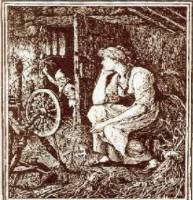
Summary
This professional development session focuses on the components of authentic learning. The session is designed to have a minimum of eight participants. Participants will connect the components of authentic learning to a Rumpelstiltskin lesson and explore ways to make their own lessons more authentic through the use of the Authenticity Learning and Teaching Rubric.
Essential Questions
How do the components of authenticity in lessons support student achievement and preparation for postsecondary success?
Snapshot
Engage
Participants will reflect on a meaningful learning experience, using the Commit and Toss strategy.
Explore
Participants will use details from the Rumpelstiltskin story to defend character actions in a mock trial, using logical arguments.
Explain
Participants will use the Jigsaw strategy to summarize the four components in the Authenticity Framework.
Extend
Participants will discuss how their assigned element of authenticity was incorporated into the Rumpelstiltskin lesson and what might be enhanced.
Evaluate
Participants will assess their learning with the 3-2-1 learning strategy, recalling what makes a lesson authentic, connecting authenticity to their own lessons, and consider follow-up questions.
Materials List
Presentation slides (attached)
Instructional Strategy Note Sheet handout (attached; one per participant; may be printed front/back)
Court Cards handout (attached; one set per group) or playing cards
Rumpelstiltskin Story handout (attached; one per participant)
Authenticity Framework Reading handout (attached; one per participant)
Claim, Evidence, Reasoning (CER) handout (attached; one per group)
Authentic Lesson Reflection Tool handout (attached; one per participant)
Wanted Posters handout (attached; number of sets depends on number of participants)
Sticky notes
Pens/pencils
Chart tablet paper
Markers
Access to Google Slides, PowerPoint, etc. for an optional activity
Learning Goals
Explore a collaborative, authentic lesson with a variety of instructional strategies and examine the components of authentic teaching and learning.
Compare different classroom environments and how they support authentic teaching and learning.
Connect authentic teaching and learning practices with the goals of the GEAR UP grant.
Preparation
45 Minute(s)
Print and prepare all attached handouts and materials before the presentation. The following should be available on the table at the beginning of the session: a Claim, Evidence, and Reasoning (CER) handout (one per table), an Instructional Strategy Note Sheet (one copy per participant), sticky notes, pens/pencils, and blank paper. The Instructional Strategy Note Sheet should be printed front/back. Pass out the other handouts as needed, according to the prompts below. Additionally, use the attached Court Cards to print and cut out a number of cards that can be evenly distributed based on the number of participants. For example, if you have eight participants, print and cut out two of each card since there are four types of cards.
Engage
10 Minute(s)
As participants enter the professional development session use the Group Shuffle strategy. Pass out one of the attached Court Cards face down to each participant. Tell them to sit wherever they would like and keep this card until the end of the session.
Begin with the attached Presentation Slides and introduce yourself to the participants. Let them know that they will be learning about authenticity and its importance in teaching.
Go to slide 3 and using the Commit and Toss strategy. Have participants write 1-2 sentences about a meaningful educational experience that they have had at any point in their lives. On your cue, have participants toss their crumpled statements around the room. Have each participant select a crumpled paper near them. Participants may read statements aloud. As the session progresses, remind participants to consider what made these experiences meaningful.
Transition to slide 4 to share the essential questions with participants. Inform them that several new instructional strategies will be introduced to them throughout the session. These strategies are tools used to support and guide higher-order thinking in an authentic way. Make sure each participant has a copy of the attached Instructional Strategy Note Sheet and encourage participants to use it to jot down their ideas for personalizing a strategy to be used as an instructional tool in their classrooms. Before breaks and after the strategies have been modeled, the presentation will allow time for participants to reflect on how to use these strategies.
Go to slide 5 to highlight the session objectives briefly. This will provide a roadmap of where you will go together during the session and will let participants know what to expect from the session.
Explore
40 Minute(s)
Go to slide 6 and have participants consider their memory of the Rumpelstiltskin story. Participants should rank their memory on a scale from 1-10 (1 being no knowledge and 10 being able to retell the story completely), then have them form a line in chronological order of how they ranked their knowledge. Using the Fold the Line strategy, have participants from both farthest ends pair together until the line is cut in half. Participants with the lower number (those with the least knowledge) share first, followed by the other person and participants learn from one another. Ask one person to summarize for the larger group.
Transition to slide 7 and pass out copies of the attached Rumpelstiltskin Story to participants. Ask participants to take a couple minutes to read this version of Rumpelstiltskin at their tables silently. Then, say: “When you entered this session, you were handed a playing card. Use that playing card to identify the character you are going to be for the next activity.”
Go to slide 8. Once participants have identified their characters, explain to them that the justice system has finally caught up with these reprehensible characters, and charges have been filed against them. In groups, they are going to defend each character against the charges. Have participants move to sit with the other participants who have the same card/character.
Go to slide 9 as participants are moving, pass out the Wanted Posters, as applicable per group. Ask participants to read through and take note of the charges that have been brought against their character.
Transition to slide 10 and introduce the CUS and Discuss strategy. Ask participants to examine the Rumpelstiltskin story again. This time, they will circle any mention of their character, underline any actions taken by their character, and star any emotions or important adjectives.
Go to slide 11 and read the example of the Claim, Evidence, Reasoning (CER) strategy. With the character information gleaned from the reading, groups will use this strategy to formulate an argument in their character's defense. Participants should use the attached Claim, Evidence, Reasoning (CER) handout as their guide in arguing their client's innocence. Transition to slide 12 for instructions on organizing the defense teams and presenting arguments.
After 20 minutes, or when everyone is finished, go to slide 13 and announce: “All rise. The Honorable Judge is in session. Which group would like to quickly present its argument first?” Ask for a group to volunteer. Then, ask the question: “Does the text-based evidence support the innocence of the character?”
Allow each group to argue the innocence of their client or character using the text as evidence to support their claim and reasoning. After each group's argument, allow the rest of the participants to give a "thumbs up" or a "thumbs down" to indicate whether the character is innocent or not. For large groups, you can appoint a judge from the audience to perform this task. Continue in this manner until each character is found innocent or guilty.
Transition to slide 14. Emphasize to participants that the subject of the lesson, the Rumpelstiltskin story, was not significant or the point of the lesson. Instead, the goal was for participants to construct a logical and supported argument based on textual evidence.
Go to slide 15 and have participants look at the Instructional Strategy Note Sheet. Explain that they have used five strategies at this point. Ask them to spend a few moments writing and reflecting on how each strategy was used and how they might incorporate each strategy into their own lessons. Allow time for participants to share their ideas for how they might use these strategies in their classrooms.
Explain
30 Minute(s)
Transition to slide 16. Explain that an authentic lesson begins with students’ accessing prior knowledge. The authentic lesson then builds on the concepts shown on the slide: Construction of Knowledge, Disciplined Inquiry, Real-World Connections, and Student-Centered Learning.
Within their previous groups, assign participants to one of the four components of the authenticity framework (see below).
Construction of Knowledge = Kings
Inquiry-based Learning = Queens
Real-World Connections = Jacks
Student-Centered Learning = Jokers
Provide copies of the Authenticity Framework Reading at this time.
Go to slide 17. Use the Jigsaw strategy to divide the reading into parts according to the detailed assignments (bullet points above).
Participants use the Why-Lighting strategy to highlight and annotate key ideas in the text. All participants read the introduction and their assigned section. Allow a few minutes for participants to read.
When everyone is finished, participants take a few minutes to discuss the reading with their group members, including what information they highlighted and why it’s important.
Go to slide 18 and pass out chart paper and markers to each group. Ask participants to work in their groups and use the GramIt strategy to construct a social media post which should include a summary sentence and a visual representation of their authenticity component.
For example, the group representing Construction of Knowledge might summarize that section as follows: When students construct their own knowledge, it sparks new ideas. They also might draw a light bulb turning on to represent new ideas being formed and create a social media post with the hashtag #knowledgeispower.
Allow time for each group to share their representations of the reading.
Extend
20 Minute(s)
Transition to slide 19 and pass out copies of the attached Authentic Lesson Reflection Tool. Inform groups that they will use this reflection tool to identify and reflect on the elements of authenticity that they observed in the Rumpelstiltskin lesson.
Assign groups to the same authenticity component that they previously read about. Using the reflection tool as a guide, have participants discuss with their groups whether the Rumpelstiltskin lesson incorporated that element of authenticity.
Have groups identify where they observed this element of authenticity in the lesson and how it might be improved. Encourage them to ask questions as they reflect: “Where was the lesson strong in terms of this element? Where was it lacking?” Allow groups to share out their responses to the whole group.
Ask participants: “How can you envision using authenticity in your own classroom instruction?” Allow small groups to discuss among themselves for a minute and then share some of their ideas with the whole group.
Take a moment to wrap-up the conversation and bring participants' attention back to the Instructional Strategy Note Sheet.
Go to slide 20 and explain that they have used three more strategies at this point. Ask them to spend a few moments writing and reflecting on how each strategy was used and how they might incorporate each strategy into their own lessons. They should also note how each strategy supports authentic instruction. This will be a great reference tool for planning lessons once they are back in the classroom.
Evaluate
15 Minute(s)
Transition to slide 21. Use the instructional strategy 3-2-1 to wrap-up the session and evaluate participants’ learning.
Ask participants to get three sticky notes each. On the first sticky note, instruct them to write three things that make a lesson authentic. On the second sticky note, they will write two authentic things they plan to implement in this week's lessons. On the third sticky note, they will write one question they still have about authenticity or authentic lessons.
Follow-up Activities
30 Minute(s)
Following up with participants, allow them to explore the K20 LEARN site to provide them with examples of authentic lessons that they can use in their classrooms. Show slide 22 to share the URL.
Research Rationale
Authenticity can be implemented in all content areas and all grade levels. Authentic teaching has four components: construction of knowledge, inquiry-based learning, real-world connections, and student-centered learning. These four components are created and apparent through authentic tasks. Authentic tasks defined by Herrington, J., et al (2014), are ill-defined, requiring students to define the tasks and subtasks needed to complete the activity. They are investigated by students over a sustained period of time. Tasks can be applied to different subject and content areas and lead with opened-ended outcomes. These tasks are seamlessly integrated with assessment and create accomplished products valuable in the student's own right. They allow for competing solutions and a diversity of outcomes.
Authentic lessons allow opportunities for collaboration, which leads to the exploration of multiple perspectives and various points of views to be heard during a lesson. By forming collaborative groups, students are able to construct knowledge. Through the use of essential, open-ended questions, teachers provide the opportunity for students to reflect and articulate their thoughts and the processes of their learning. Herrington, J. et al. identify the partners in authentic learning environments: "Authentic learning environments need to provide collaborative learning where, for example, more able partners can assist with scaffolding and coaching, and where teachers provide appropriate learning support" (Herrington, J., 2014; e.g., Collins et al., 1989; Greenfield, 1984).
Herrington, J. et al., describes the four components in an authentic lesson as follows: 1) Students should seek to solve a real-life problem to which they would attach emotional commitment as well as a cognitive interest; 2) The problem should be sufficiently open-ended so that there are a variety of strategies for its solution; 3) The problem-solving strategies and "solutions" developed should encourage students to change their actions, beliefs, or attitudes; and 4) The problem should have a real audience beyond the classroom. Authentic tasks are more worthy of the investment of time and effort in higher education than de-contextualized exercises and tasks (Herrington & Herrington, 2006).
Resources
Bulgren, J. A., & Ellis, J. D. (2012). Argumentation and evaluation intervention in science classes: Teaching and learning with Toulmin. In Perspectives on Scientific Argumentation (pp. 135-154). Springer Netherlands.
Collins, A., Brown, J. S., & Newman. S. E. (1989). Cognitive apprenticeship: Teaching the crafts of reading, writing, and mathematics. In L. B. Resnick (Ed.). Knowing, learning and instruction: Essays in honor of Robert Glaser (pp. 453-494). Hillsdale, NJ: LEA.
Greenfield, P. M. (1984). A theory of the teacher in the learning activities of everyday life. In B. Rogoff & J. Lave (Eds.), Everyday cognition: Its development in social context (pp. 117-138). Cambridge, MA: Harvard University Press.
Herrington, A., & Herrington, J. (2006). Authentic learning environments in higher education. Hershey, PA: Information Science Publishing.
Herrington, J., Reeves, T. C., & Oliver, R. (2014). Authentic learning environments. In Handbook of research on educational communications and technology (pp. 401-412). Springer New York.
K20 Center. (n.d.). 3-2-1. Strategies. https://learn.k20center.ou.edu/strategy/117
K20 Center. (n.d.).
Claim, evidence, reasoning (CER). Strategies. https://learn.k20center.ou.edu/strategy/156
K20 Center. (n.d.).
Commit and Toss. Strategies. https://learn.k20center.ou.edu/strategy/119
K20 Center. (n.d.).
CUS and discuss. Strategies. https://learn.k20center.ou.edu/strategy/162
K20 Center. (n.d.).
Fold the line. Strategies. https://learn.k20center.ou.edu/strategy/171
K20 Center. (n.d.).
GramIt. Strategies. https://learn.k20center.ou.edu/strategy/2554
K20 Center. (n.d.). Group Shuffle. Strategies. https://learn.k20center.ou.edu/strategy/4441
K20 Center. (n.d.).
Jigsaw. Strategies. https://learn.k20center.ou.edu/strategy/179
K20 Center. (n.d.).
Why-lighting. Strategies. https://learn.k20center.ou.edu/strategy/128
Printable Board Games. (2014-2016). Printable playing card deck. https://www.printableboardgames.net/preview/Playing_Card_Deck