


Summary
This session provides an overview for middle school staff whose institutions are recipients of the 2025 GEAR UP the METRO project. The session aims to introduce staff to the K20 Center, explain what GEAR UP is, highlight the value of authentic teaching and learning, and communicate the value of college-going culture.
Essential Questions
How can the GEAR UP the METRO grant and the K20 Center support and increase students’ and families’ college and career awareness?
Learning Objectives
Identify characteristics and generate questions about the K20 Center and its research-based professional development approaches.
Identify characteristics and generate questions about goals, benefits, and expectations for participation in the GEAR UP the METRO grant.
Connect the benefits and potential impact of college to the real-life experiences of a student whom they know.
Examine upcoming grant events and register for those that align with supporting GEAR UP goals.
Snapshot
Engage
Establish a community using Snap, Clap and Pop as an icebreaker.
Explore
Using the strategy, I Notice, I Wonder, discover college-going culture components, the mission and services of K20, and the benefits of college to students.
Explain
Make connections between the grant services offered and benefits to school.
Extend
Using strategy 3-2-1, consider an individual or group of students that GEAR UP the METRO services would benefit.
Evaluate
Review and register for upcoming GEAR UP events that support grant goals.
Materials List
Presentation Slides (attached)
GEAR UP Overview infographic (attached; 1-2 copies)
GEAR UP Overview Booklet (attached)
I Notice, I Wonder handout (attached)
Sticky Notes, two different colors
3-2-1 handout (attached)
Preparation
25 Minute(s)
Before facilitating this session, print a poster-sized version of the GEAR UP Overview Infographic and post it on a wall. Depending on the size of the whole group, two large infographic posters may be needed for the Explore activity. In this case, place the two posters on opposite sides of the room.
You will also need to customize slide 24 for each session that you present. Insert a new link and QR code for your evaluation.
Engage
30 Minute(s)
Welcome participants and introduce yourself and the session using the attached Presentation Slides.
Display slide 2. Introduce the Snap, Clap, Pop strategy to establish community and model the K20 LEARN strategies, as well as the authentic teaching and learning that guide our professional development. Inform participants that the activity is an example of an engaging and rigorous instructional strategy that they can use in their classroom. This entire overview session is embedded with other strategies that are appropriate for modification to their content.
One by one, ask participants to perform the associated action after you read the “If…“ statement. To start, tell participants “to give a wave if you’ve attended a K20 event or PD before.” Move through the list as time permits.
You have attended a K20 event or Professional Development (PD) before… Give a wave!
You think quality PD should model strategies… Say, “Here, Here!”
You teach social studies or ELA… Pose as if you’re writing an essay or a story.
You teach science or math… Pose as if you’re pondering the answer to a problem.
You teach another subject… Act out your subject.
You are a first-generation college student… Raise a number 1!
You participated in GEAR UP before… Shout out your role!
Middle school is your jam… Say a phrase you hear every day.
After this activity, go to slide 3 to share the session objectives with participants.
Explore
60 Minute(s)
Display slide 4. In this activity, participants will explore an infographic overview of the K20 Center, the METRO grant's research-based approaches, GEAR UP, and student benefits of postsecondary and college opportunities. Pass out copies of the GEAR UP Overview Booklet, one per person or one per table, if copies are limited.
Move to slide 5. Introduce the I Notice, I Wonder instructional strategy and pass out a copy of the I Notice, I Wonder handout. Assign each group either the left side or the right side of the infographic (pages 2-3 of the booklet). First as individuals, have participants record what they notice (true statements) on a sticky note of one color and a wonder (question they have) on a separate sticky note of a different color.
Share the following as examples:
I notice that the K20 Center is centered around collaboration with the university, community, and school.
I wonder how the community is involved in the collaboration piece.
Give participants three minutes to look over their side of the infographic and record their responses.
Display slide 6 as groups complete their I Notice, I Wonder. If desired, display the K20 Center three-minute timer to time participants.
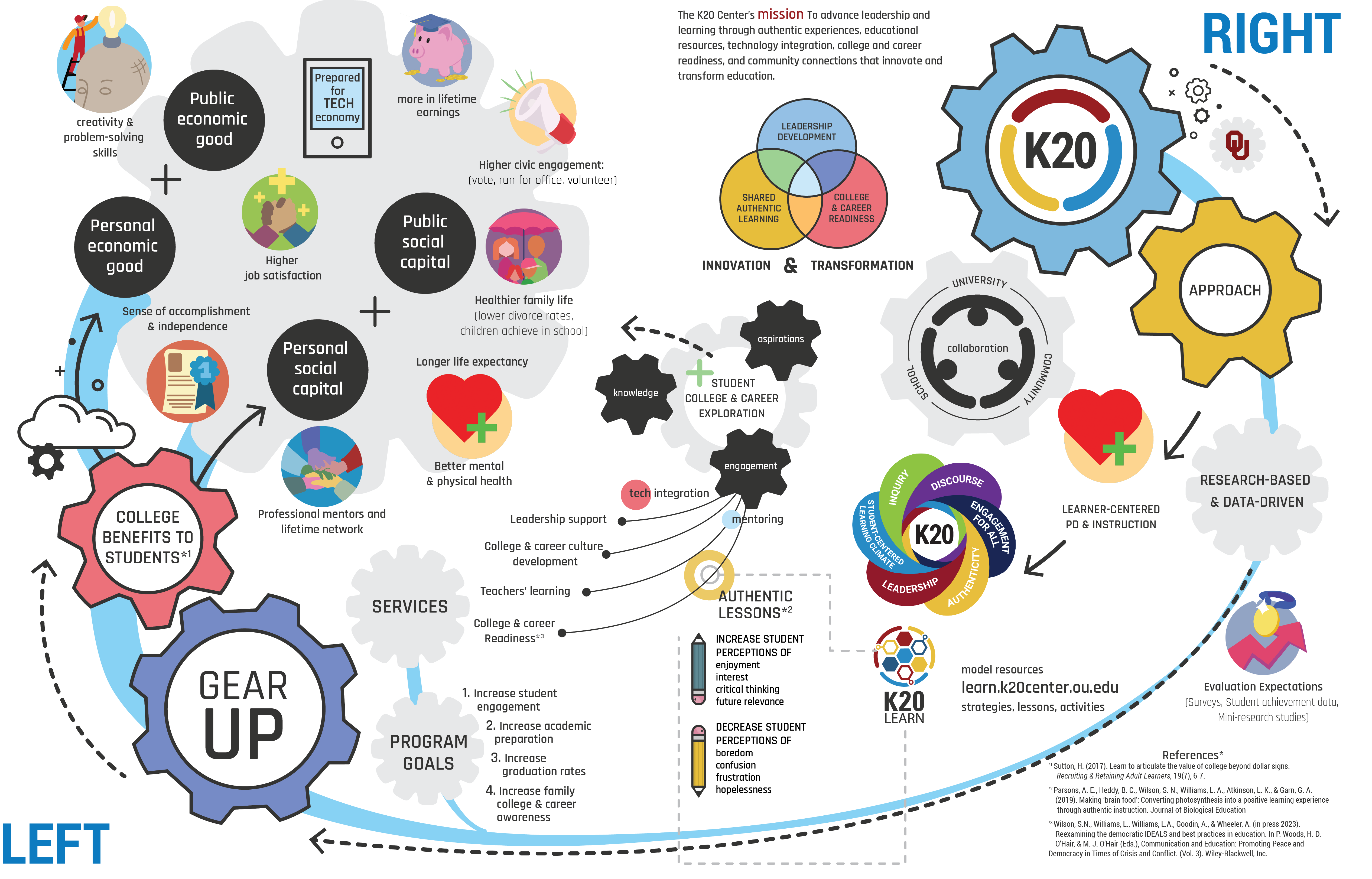
Display slide 7. As a group, invite participants to choose one I Notice and one I Wonder statement and place each sticky note on the poster-sized infographic hanging on the wall. After participants have placed their stickies, lead a whole-group discussion on what they noticed and wondered.
Move to slide 8 and ask participants “What did you notice and wonder about the K20 Center and research-based approaches?“
Move to slide 9 and explain anything not already covered, such as that the K20 Center is an educational research and development center that provides professional developments to educators across the state. Point out the IDEALS and explain that the acronym stands for Inquiry, Discourse, Engagement for All, Authenticity, Leadership, and Student-Centered Learning Climate.
Move to slide 10 and ask “What did you notice and wonder about college benefits to students?“ Move to slide 11 as participants share. Move to slide 12 and discuss any benefits not already addressed. Make sure to expand on the four main benefits:
Personal economic good refers to outcomes that have a positive effect on students financially. These outcomes might affect salary differentials or employment opportunities. A bachelor's degree can allow a student to earn $1 million more than a high school graduate over the course of their career.
Public economic good refers to ways in which college graduates benefit the financial status of the community, region, state, or nation in which they live. These benefits might include things such as taxes, charitable contributions, or filled jobs.
Personal social capital relates to a person's individual development. These outcomes can cover a broad range of skills like critical thinking, understanding of international perspectives, and interpersonal skills.
Public social capital refers to the social benefits to a community. These benefits can include civic engagement, building a community of shared values, and involvement in nonprofits, teaching, and healthcare.
Transition to slides 13-14 to provide an overview of the GEAR UP program, the cohort model, and the map of cohort schools. Next, move to slide 15 and ask participants “What does GEAR UP the METRO mean for our schools?“
Move to slide 16 as you lead a discussion on the goals of the GEAR UP the METRO grant.
Explain
40 Minute(s)
Transition to slide 17 and play the GEAR UP Overview video so participants can hear GEAR UP grant success stories from students and teachers. Let participants know the next few slides introduce them to services provided to cohort schools.
Move to slide 18 and introduce Micro-credentialing. This service consists of online-only self-paced professional learning broken down into short courses. Topics include classroom procedures and rules, instructional strategies, authentic teaching practices, and more.
Move to slide 19 and introduce participants to the ADEPT Live service. Explain this is a year-long professional learning experience. Teachers attend a summer workshop; then they work with an instructional coach to build a skillset focused on a student-centered constructivist teaching approach with the goal of engaging students in active learning.
Move to slide 20 and introduce Mentoring opportunities. Provide the staff with an overview of Career Cafes, Zoom Into Your Career, and support provided for Career Fairs.
Next, display slide 21 and review the types of services provided by GEAR UP the METRO. Explain that all services are led by K20 staff and designed to meet grant goals.
Extend
30 Minute(s)
Display side 22 and introduce the 3-2-1 instructional strategy. Pass out copies of the 3-2-1 handout, one per person. Have participants record
Three (3) student benefits of postsecondary education.
Two (2) benefits the METRO grant provides their school.
One (1) student, or group of students they can envision this grant affecting. Remind them to use a pseudonym or a description that does not include student-specific identifiers.
Ask participants to think about the student or group of students they noted in the 3-2-1. Have participants consider the following:
How will this partnership make a difference for your student(s)?
What does that difference look like to you?
After participants have reflected and shared their answers, have participants look at the “picture frame” and the Starfish Story on the bottom portion of the 3-2-1 handout. Ask participants to follow along as you read the story aloud to the whole group. After reading the story, reinforce to participants that this GEAR UP the METRO grant can benefit and provide opportunities to all students. However, keeping particular students in mind helps us give meaning and a personal connection to the work we are doing.
If time permits, ask participants to draw a one-frame Cognitive Comic that shows how this GEAR UP grant will make a difference for the student(s) they have in mind.
Evaluate
30 Minute(s)
After participants connect the benefits and impact of GEAR UP the METRO with a student or group of students they know, review upcoming GEAR UP the METRO services and ask them to consider which ones they want to sign up for.
Move to slide 23 and tell participants to complete the survey. The survey asks them to select their role and events they might be interested in attending.
Move to slide 24 and review the LEARN strategies used in the session with participants. Remind them to make notes about each strategy using the note catcher in the GEAR UP Overview booklet (page 11). Ask them to share how they might use any of the strategies in their classroom. Showcase the LEARN website and all of the available resources available to them.
Display slide 25. Have participants complete the session evaluation form. Move to slide 26 and ask if anyone has questions.
Follow-Up Activities
Provide participants with the Student Kickoff Activity (Assembly) or the Student Kickoff Activity (classroom) resources.
Research Rationale
College can be a life-altering experience for students, and not only academically. Earning a bachelor’s degree allows students to earn, on average, $1 million more than high school graduates over the course of their careers (Starrett et al., 2022; Abel & Deitz, 2014). College graduates tend to have greater job satisfaction, jobs that offer a greater sense of accomplishment, more independence and opportunities for creativity, and more social interaction in their jobs than non-college graduates (Oreopoulos & Petronijevic, 2013; Sutton, 2017; Wolniak & Engberg, 2019). College graduates tend to carry more benefits forward into their family lives, including a lower likelihood of divorce and higher-achieving children (Oreopoulos & Petronijevic, 2013; Reynolds, 2021).
Resources
K20 Center. (n.d.). 3-2-1. Strategies. https://learn.k20center.ou.edu/strategy/117
K20 Center. (n.d.). Cognitive Comics. Strategies. https://learn.k20center.ou.edu/strategy/198
K20 Center. (2023, November 8). GEAR UP Overview. YouTube.
K20 Center. (n.d.). I notice, I wonder. Strategies. https://learn.k20center.ou.edu/strategy/180
K20 Center. (n.d.). Snap, clap, pop. Strategies. https://learn.k20center.ou.edu/strategy/190
K20 Center. (n.d.). Timer. https://timer.k20center.ou.edu/