

Summary
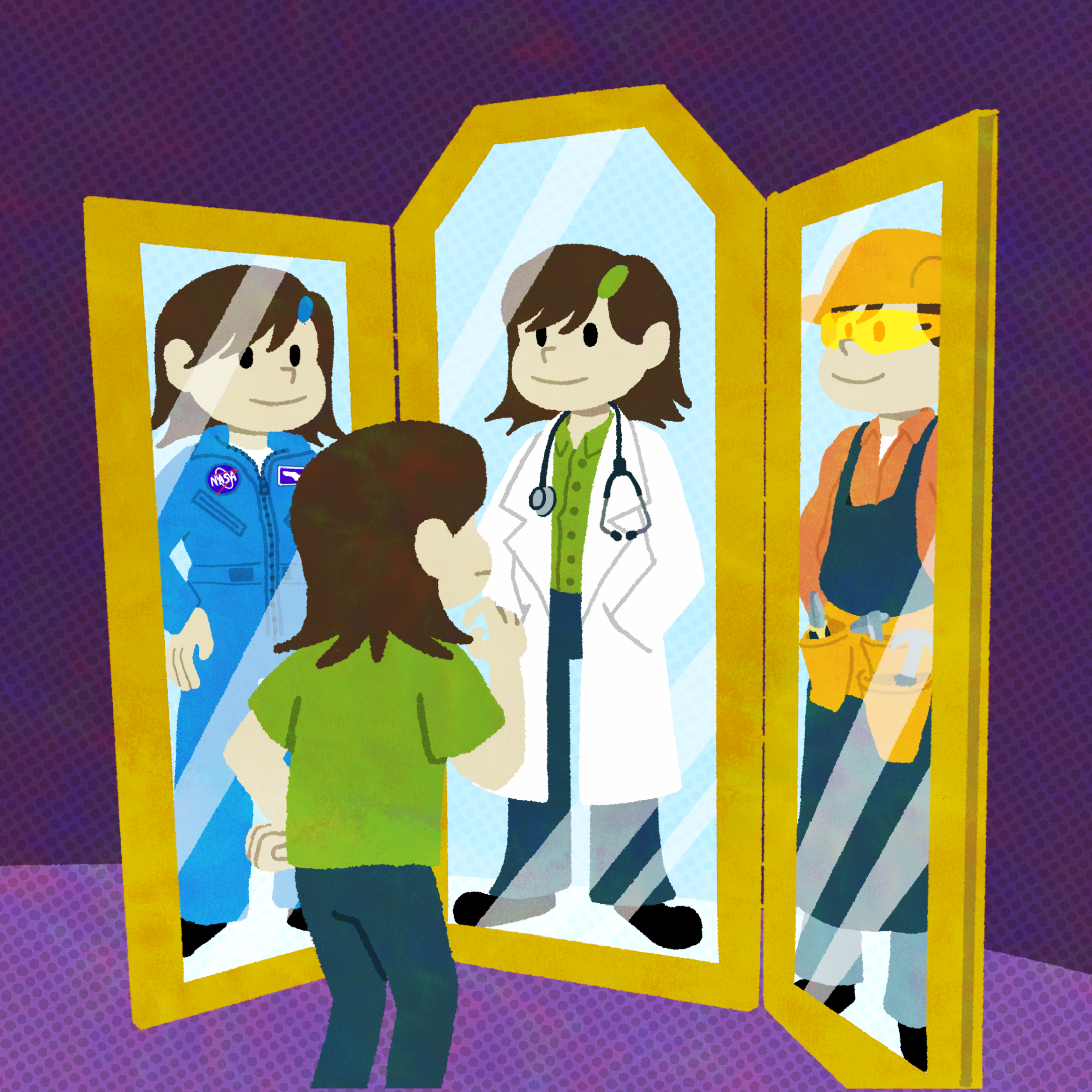
In this session, participants will consider the challenges that first-generation college students have with finding success in STEM programs. Participants will explore different types of interventions—representation, exposure, and coursework—and collaborate on ways to make a difference at their school for their students.
Essential Question
How do we get students interested in STEM degree plans?
Learning Objective
Identify different types of interventions to support first-generation students’ interests in STEM degree plans.
Snapshot
Engage
Participants consider the meaning of the terms first-generation and STEM.
Explore
Participants read quotes from research articles and reflect on how they feel about challenges surrounding first-generation college students pursuing STEM degrees.
Explain
Participants formalize their understanding of representation, exposure, and coursework and the impact these interventions can have on first-generation students.
Extend
Participants collaborate to generate ideas on how to integrate representation, exposure, and coursework into their schools.
Evaluate
Participants reflect on their learning and consider ways to support students interested in STEM degrees.
Materials List
Presentation Slides (attached)
Magnetic Statements posters (attached; one set per session; print one-sided)
Making a Difference handout (attached; one per participant; print one-sided)
Spotlight STEM Success handout (attached; one per participant; print two-sided)
Chart paper or giant sticky notes (three sheets)
Markers (one per participant)
Preparation
Prior to the session, prepare three sheets of chart paper by labeling them: “Representation,” “Exposure,” and “Coursework.” Do not hang these until after the Explain phase of the learning experience. If you anticipate having a large session, consider having multiples of these so that groups can comfortably gather around, read, and write on the chart paper.
Print the attached Magnetic Statements posters and decide where you would like to hang them for the Explore portion of the session. The attachment is a six page document, where pages 1–5 each have a quote and are intended to be hung around the room for participants to gather around. The last page contains a list of the quotes with their corresponding sources. As the facilitator, you may find it helpful to use this page as a reference, whether that be digitally or as a printed page.
Engage
10 Minute(s)
Use the attached Presentation Slides to guide the session. Display slide 3 as participants enter the room. As the session begins, ask participants what comes to mind when they hear the term first-generation. Have participants discuss with others at their table for a few moments or ask volunteers to share their thoughts with the whole group.
Move to slide 4 and share that the term “first-generation” can have different meanings, and for this session, you should be using first-generation to refer to students who do not have a parent or guardian who attended college.
Repeat this process again using slides 5–6 for the term STEM. Help participants understand that this shared understanding of vocabulary is what should be used throughout the session.
Transition through slides 7–8 and introduce the essential question and learning objective.
Explore
20 Minute(s)
Display slide 9 and share the Magnetic Statements strategy with your participants. Read the statements around the room. Consider using the last page of the attached Magnetic Statements posters for quick reference. Instruct participants to choose the statement that most repels them.
After a couple of minutes or when participants have all gathered into groups, show slide 10. Tell participants they have five minutes to discuss within their groups the following prompts from the slide and select a spokesperson:
Why did you choose this statement?
What is one way it can be reversed, solved, or fixed?
What is something we can do?
Start the 5-minute timer on the slide.
As time allows, ask volunteers to read their Magnetic Statement and share their group’s response for one of the prompts.
Magnetic Statement 1: “...First-generation college students were less likely to take the sort of rigorous math and science courses in high school that allow for a smoother transition into STEM majors.” (Bettencourt et al., 2020, p. 768)
Magnetic Statement 2: “...[First-generation college students] are less likely to know what careers are available to them, as well as what any particular job will include on a day-to-day basis…” (Coleman et al., 2025, p. 49)
Magnetic Statement 3: “46% (13 of 28) of [first-generation college students] spoke of hidden expectations within STEM departments that shaped their perceptions of what students should know at the undergraduate level or how they should act as a STEM student.” (Google et al., 2023, p. 13)
Magnetic Statement 4: “Compared to continuing-generation students, first-generation students had significantly lower self-efficacy, emotional regulation, first-semester [college] GPA, and first-to-second year retention…” (Koh et al., 2022, p. 1078)
Magnetic Statement 5: “...[First-generation college students] constitute 30% of undergraduate degrees...” (Marco-Bujosa et al., 2024, p. 906)
Explain
20 Minute(s)
Display slide 11 and give each participant a copy of the attached Making a Difference handout. Explain the three ways educators can make a difference in their school(s): representation, exposure, and coursework.
Explain that representation makes a difference because when students can see people who look like them from similar backgrounds and circumstances thriving in STEM careers, they can envision more possibilities. Explain that representation sends the message to students that “this path is for me too.”
Explain that exposure allows students to explore hands-on experiences like mentoring relationships, internships, and enrichment programs. These experiences give students a real taste of STEM in practice, building both skills and a sense of belonging that keeps them engaged. Lastly, when students have access to rigorous STEM coursework in high school, they arrive at postsecondary environments better prepared and more confident.
Move through slides 12–14 and share the respective attributed information about representation, exposure, and coursework to share evidence that these interventions are transformative.
Slide 12: When students completed assignments featuring a variety of scientists, first-generation students increased their ability to relate, which provided a stronger sense of belonging. (Metzger et al., 2023)
Slide 13: Students with experiences in STEM during secondary school impact college STEM success. (Bettencourt et al., 2020)
Slide 14: High school students who completed courses that were similar to the rigor of college-level courses were better prepared for STEM coursework. This preparation helped students finish challenging coursework despite obstacles. (Carver et al., 2017)
Move to slide 15 and give each participant one copy of the attached Spotlight STEM Success handout. Explain the available resources for each intervention. Explain that the Spotlight STEM Success handout is a resource to support representation. Share that the handout offers ways that participants can showcase a variety of STEM professions throughout the school year.
Share that the STEM Challenge Curriculum collection and the College2Career Forum: How To Guide resource support exposure. Share that these resources engage students in hands-on, inquiry-based activities in the classroom with career professionals.
Share that the Power Up: Science ACT Prep and Power Up: Math ACT Prep resources support coursework; these are each 10-week lessons to integrate into existing science and math curriculum, respectively.
Extend
15 Minute(s)
Display slide 16 and introduce the Chalk Talk instructional strategy. Distribute a marker to each participant and preview the activity. Explain that they are to visit each of the three posters, labeled “Representation,” “Exposure,” and “Coursework.” At each poster, they should write ideas for actions they could take to support each intervention. When they are at a poster that already has ideas, they need to respond to others’ ideas, using words, drawings, etc., and add new ideas. As they visit the posters, they should remain silent, only representing their thoughts using their marker on the chart paper.
Evaluate
5 Minute(s)
Display slide 17 and share the What? So What? Now What? instructional strategy. Direct participants to write their responses to the following prompts on the back of their handout:
What stood out to you regarding what you learned today?
Why do you think first-generation college students need tailored supports?
In what ways can you support first-generation college students interested in STEM degrees?
If time allows, invite volunteers to share their responses.
Follow-Up Activities
As mentioned during the Explain phase of the learning experience, use the following resources to implement the interventions at your school:
Research Rationale
Careers in science, technology, engineering, and mathematics (STEM) are increasing, and there is a need to develop and nurture STEM talents in the United States (Pearson et al., 2022). First-generation college students (FGCS) are significantly underrepresented in STEM fields; this disparity is driven by higher dropout rates and the burden of navigating unspoken departmental expectations that many are unprepared for without prior family guidance (Google et al., 2023; Marco-Bujosa et al., 2024; Peña et al., 2022; Riegle-Crumb et al., 2019). Prior to college, STEM experiences influence the selection of a major and can be a predictor of success in courses (Bettencourt et al., 2020). FGCS lack the social capital of their middle-to-upper-class peers and thus struggle in their college and career readiness experiences (Almeida et al., 2019). Research shows that representation of first-generation students helps to increase student achievement in coursework (Mowreader, 2023).
Resources
Almeida, D. J., Byrne, A. M., Smith, R. M., & Ruiz, S. (2021). How relevant is grit? The importance of social capital in first-generation college students’ academic success. Journal of College Student Retention?: Research, Theory & Practice, 23(3), 539–559. https://doi.org/10.1177/1521025119854688
Bettencourt, G. M., Manly, C. A., Kimball, E., & Wells, R. S. (2020). STEM degree completion and first-generation college students: A cumulative disadvantage approach to the outcomes gap. The Review of Higher Education, 43(3), 753–779. https://doi.org/10.1353/rhe.2020.0006
Carver, S. D., Van Sickle, J., Holcomb, J. P., Jackson, D. K., Resnick, A., Duffy S. F., Sridhar, N., Marquard, A., Quinn, C. (2017). Operation STEM: Increasing success and improving retention among mathematically underprepared students in STEM. Journal of STEM Education, 18(3), 20–29. https://www.jstem.org/jstem/index.php/JSTEM/article/view/2182/1891
Coleman, M. C., Hoffman, B. Y., & Cirucci, A. M. (2025). Communicatively enhancing belonging by meeting the motivations of first-generation college students in the classroom. Journal of Communication Pedagogy, 9, 43–51. https://doi.org/10.31446/JCP.2025.1.04
Google, A., Sekaya, G., McMullen, Z., & Henning, J. (2023). Adopting a multi-systems approach: Examining the academic belongingness of first-generation college students with multiple stigmatized identities in STEM. Frontiers in Education, 8. https://doi.org/10.3389/feduc.2023.1183907
K20 Center. (n.d.). Chalk talk. Strategies. https://learn.k20center.ou.edu/strategy/197
K20 Center. (n.d.). College2Career forum: How to guide. Educator Resource. https://learn.k20center.ou.edu/educator-resource/1964
K20 Center. (n.d.). Magnetic statements. Strategies. https://learn.k20center.ou.edu/strategy/166
K20 Center. (n.d.). Mentimeter. Tech Tools. https://learn.k20center.ou.edu/tech-tool/645
K20 Center. (n.d.). Power up: Math ACT prep 10 week series. Collection. https://learn.k20center.ou.edu/collection/3212
K20 Center. (n.d.). Power up: Science ACT prep 10 week series. Collection. https://learn.k20center.ou.edu/collection/3213
K20 Center. (n.d.). Slido. Tech Tools. https://learn.k20center.ou.edu/tech-tool/4985
K20 Center. (n.d.). STEM challenge curriculum. Collection. https://learn.k20center.ou.edu/collection/5024
K20 Center. (n.d.). What? So what? Now what? Strategies. https://learn.k20center.ou.edu/strategy/95
K20 Center. (2021, September 21). K20 Center 5-minute timer [Video]. YouTube. https://www.youtube.com/watch?v=EVS_yYQoLJg
Koh, J., Farruggia, S. P., Back, L. T., Han, C. (2022). Self-efficacy and academic success among diverse first-generation college students: The mediating role of self-regulation. Social Psychology of Education, 25, 1071–1092. https://doi.org/10.1007/s11218-022-09713-7
Marco-Bujosa, L. M., Baker, L., & Malott, K. M. (2024). “Why am I here?”: A phenomenological exploration of first-generation college student experiences in STEM majors within a predominantly white institution. Journal of Research in Science Teaching, 61(4), 905–936. https://doi.org/10.1002/tea.21911
Metzger, K. J., Dingel, M., & Brown, E. (2023). “No matter what your story is, there is a place for you in science”: Students’ ability to relate to scientists positively shifts after scientist spotlight assignments, especially for first-generation students and women. CBE Life Sciences Education, 22(1). https://doi.org/10.1187/cbe.22-06-0103
Moschetti, R. V., & Hudley, C. (2015). Social capital and academic motivation among first-generation community college students. Community College Journal of Research and Practice, 39(3), 235–351. https://doi.org/10.1080/10668926.2013.819304
Mowreader, A. (2023). Report: STEM classes with racial, socioeconomic representation book student GPA. Inside Higher Ed. https://www.insidehighered.com/news/student-success/academic-life/2023/12/18/study-college-students-perform-better-diverse-stem#:~:text=Report
National Science Board. (2018). Science and engineering indicators. National Science Foundation. https://files.eric.ed.gov/fulltext/ED604486.pdf
Pearson, J., Giacumo, L. A., Farid, A., & Sadegh, M. (2022). A systematic multiple studies review of low-income, first-generation, and underrepresented, STEM-degree support programs: Emerging evidence-based models and recommendations. Education Sciences, 12(5), 333. https://doi.org/10.3390/educsci12050333
Peña, C., Ruedas-Gracia, N., Cohen, J. R., Tran, N., & Stratton, M. B. (2022). Ten simple rules for successfully supporting first-generation/low-income (FLI) students in STEM. PLOS Computational Biology, 18(10). https://doi.org/10.1371/journal.pcbi.1010499
Riegle-Crumb, C., King, B., & Irizarry, Y. (2019). Does STEM stand out? Examining racial/ethnic gaps in persistence across postsecondary fields. Educational Researcher, 48(3), 133–144. https://doi.org/10.3102/0013189X19831006