

Summary
These instructional strategies position students as active teachers who explicitly explain concepts and demonstrate understanding to classmates through intentional activities. Research on elaborative encoding, the protégé effect, and social constructivism demonstrates that students deepen their own understanding when they teach others (Vygotsky, 1978; Topping, 2005; Fiorella & Mayer, 2013). These strategies differ from general collaborative learning by emphasizing the teaching role that students assume rather than simply working together on tasks. Through activities where teaching and learning roles may alternate, students develop metacognitive awareness while supporting peers' comprehension. These strategies are particularly effective for reviewing content, building communication skills, creating student-centered environments, and providing differentiated instruction through multiple student-generated explanations of the same concepts.Resources
30-Second Expert
- 3rd - 12th
This collaborative strategy can be used to introduce new material or to review texts that students have read. 30-Second Expert helps students summarize and synthesize information in a brief, reciprocal activity. Read more »
Created by: Shelby Blackwood
July 16th, 2026
- Small Group
- Engage/Opening, Explore/Learning Activity, Explain/Closing, Evaluate/Assessment
- 10 - 20 Minutes
- Active Engagement, Collaborate, Conversation Starter, Critical Thinking, Interpret, Review, Speak & Listen, Summarize, Synthesize
- 3rd - 12th
Students take turns in explicit 'expert' and 'listener' roles, with the expert sharing knowledge about a topic for 30 seconds while the listener actively processes, summarizes, and asks clarifying questions. Roles then reverse so that both students teach and learn from each other through brief, focused exchanges.

Chant It, Sing It, Rap It
- Preschool - 12th
This strategy uses music and teamwork to promote communication skills, review prior knowledge, and teach new concepts. Read more »
Created by: K20 Center
July 6th, 2026
- Explain/Closing, Evaluate/Assessment
- Less Than 10 Minutes, 10 - 20 Minutes
- Brainstorming, Collaborate, Elaborate, Evaluate, Reflection
- Preschool - 12th
Students identify essential concepts and compose a chant, song, or rap specifically designed to teach content to classmates in a memorable way. Teams perform their creations for the class, positioning students as content creators and peer teachers who determine what is essential for peers to understand and find creative ways to make that content accessible through performance.
Expert Stay and Stray
- 4th - Secondary
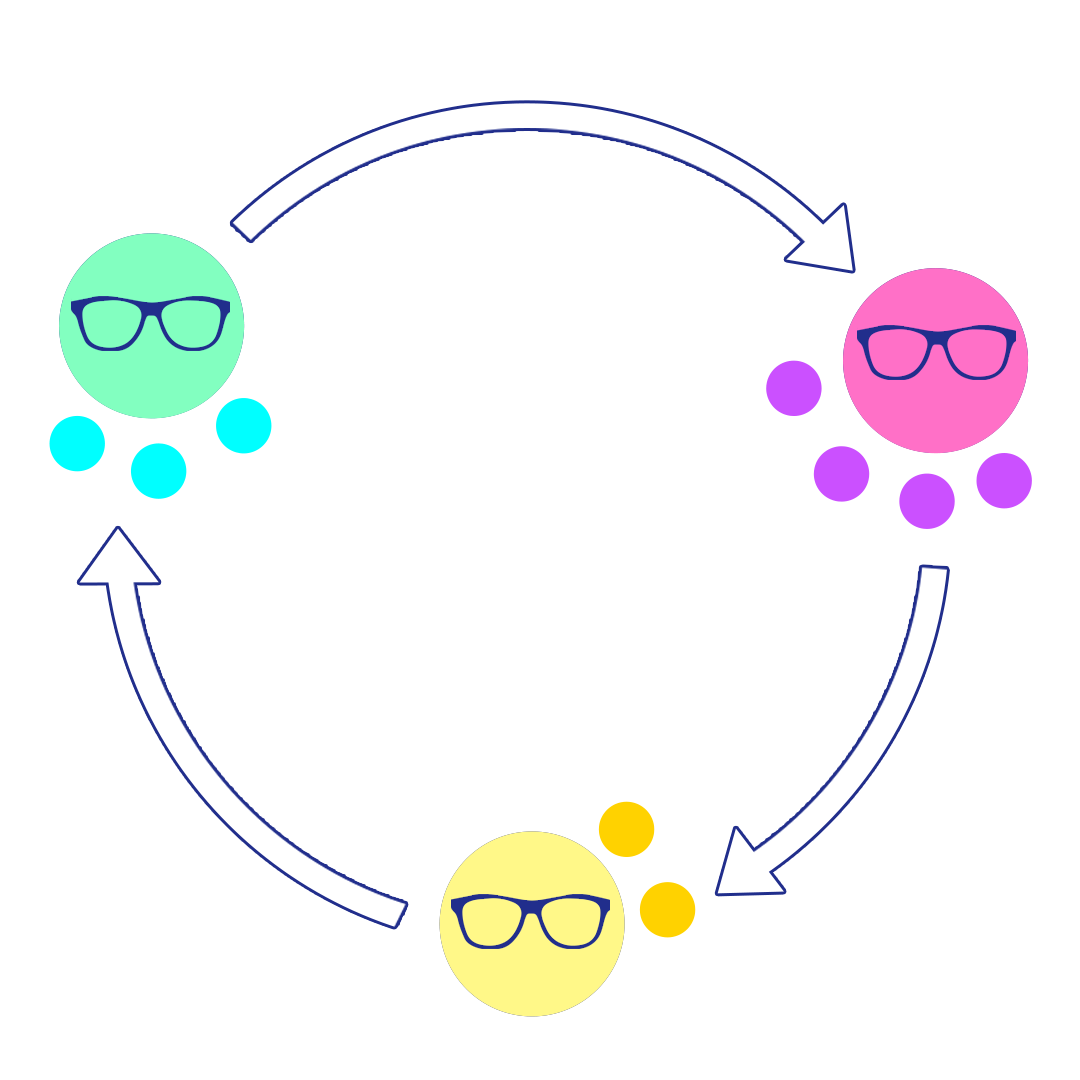
This collaborative learning strategy keeps students engaged as they listen and learn, take turns being the expert, and rotate through stations. Read more »
Created by: Laura Young
August 4th, 2026
- Large Group (at least 30), Medium Group (at least 10), Whole Class
- Extend/Additional Learning Activity, Evaluate/Assessment
- 20 - 30 Minutes, More Than 30 Minutes
- Active Engagement, Collaborate, Compare & Contrast, Critical Thinking, Elaborate, Physical Movement, Present, Reason, Review, Speak & Listen, Summarize
- 4th - Secondary
Students develop expertise in groups with the explicit expectation that everyone can explain the content to others. One student stays at their station as the designated expert to teach while others stray to different stations to learn from other experts. Students rotate through multiple teaching opportunities, deepening mastery through repeated explanation to different audiences.

Inverted Pyramid
- 11th - 12th
This strategy can be used to explore essential questions, concepts, texts, infographics, or videos. It also serves as a framework for classroom grouping and analysis discussions that can build student confidence and expand perspectives. Read more »
Created by: K20 Center
September 15th, 2026
- Individual, Whole Class
- Explain/Closing
- 20 - 30 Minutes
- Analyze, Collaborate, Compare & Contrast, Critical Thinking, Physical Movement, Summarize, Synthesize, Writing
- 11th - 12th
Students analyze a concept independently, then pair up to teach each other their perspectives. Pairs join with another pair to form groups of four, where students share thinking that now incorporates what they learned from their first partner. This continues with progressively larger groups, ensuring that students repeatedly articulate and refine their understanding while learning from an increasing number of peer perspectives until reaching whole-class discussion.

Jigsaw
- 3rd - 12th
This strategy breaks up complex readings into smaller parts to be shared among multiple students. This practice encourages students to share responsibility for one another's learning while developing group communication skills and practicing close reading. Read more »
Created by: K20 Center
September 15th, 2026
- Large Group (at least 30), Medium Group (at least 10), Small Group (at least 4), Whole Class
- Explore/Learning Activity, Explain/Closing
- 10 - 20 Minutes, 20 - 30 Minutes
- Collaborate, Conversation Starter, Critical Thinking, Interpret, Organize, Summarize
- 3rd - 12th
Students are divided into 'expert groups' where each group masters one portion of content; students are then reorganized into 'teaching groups' composed of one expert from each original group. Each student has explicit responsibility to teach their content to peers who studied different material, creating a reciprocal structure where everyone both teaches their expertise and learns from classmate-teachers.

Margin Mates
- 6th - 12th
Margin Mates is a contemporary approach to peer editing that uses digital tools to enhance collaboration and feedback quality. Students will also develop digital literacy competencies that extend beyond the classroom into professional and academic contexts. Read more »
Created by: Polly Base
September 16th, 2026
- Small Group
- Explain/Closing, Extend/Additional Learning Activity, Evaluate/Assessment
- 10 - 20 Minutes
- Collaborate, Text analysis, Writing
- 6th - 12th
Students engage in digital peer editing by reading and commenting on each other's work using structured feedback categories—identifying strengths, suggesting improvements, asking clarifying questions, and making connections. This positions students as peer teachers who guide revision through questions and suggestions, creating an ongoing dialogue where peers teach each other about effective writing through an iterative cycle of feedback and revision.

Math Interview
- 6th - Secondary
This math strategy encourages students to deepen their math understanding. Students conduct an interview with a partner to help them ask meaningful questions, have productive discourse, use academic language, and reflect metacognitively. Read more »
Created by: Samaya Williams
September 24th, 2026
- Small Group
- Explain/Closing, Extend/Additional Learning Activity, Evaluate/Assessment
- More Than 30 Minutes
- Active Engagement, Collaborate, Conversation Starter, Critical Thinking, Elaborate, Evaluate, Problem Solving, Reason, Reflection, Review, Self-assessment, Speak & Listen, Writing Across Curriculum
- 6th - Secondary
Students work in pairs, each solving a different mathematics problem independently. Partners then interview each other using guided prompts, with one student explaining their mathematical thinking and problem-solving process in detail while the other asks questions. Roles reverse after the first interview, ensuring that both students teach their reasoning process and learn from their partner's approaches.

Novel in a Day
- 6th - 12th
This strategy breaks a novel down into portions and invites students to take responsibility for reading, learning, and teaching their peers a single section. Students work in small groups to read and analyze a portion of a novel, then present it to the class. Meanwhile, the class makes observations,... Read more »
Created by: Chelsee Wilson
September 25th, 2026
- Whole Class
- Explain/Closing
- More Than 30 Minutes
- Collaborate, Interpret, Summarize
- 6th - 12th
A novel is divided into sections with groups assigned responsibility for reading, analyzing, and teaching one section to the class. Groups present sequentially in plot order, with each group taking on explicit teaching responsibility for their portion. Other students learn the novel through peer-taught presentations, with presenting groups ensuring classmates understand plot, characters, themes, and literary elements of their assigned section.
Paired Reading
- Preschool - 3rd
Working together with a partner, students read and summarize a piece of text. This strategy is great for breaking up texts into manageable pieces while simultaneously sharpening students' listening and comprehension skills. Read more »
Created by: Kristen Sublett
July 14th, 2026
- Small Group
- Explore/Learning Activity, Explain/Closing, Extend/Additional Learning Activity
- Less Than 10 Minutes, 10 - 20 Minutes, 20 - 30 Minutes
- Speak & Listen, Summarize
- Preschool - 3rd
Students work in pairs to read and analyze texts together, taking turns reading aloud and pausing to discuss, question, predict, and clarify understanding. Throughout this process, students teach each other by explaining interpretations, sharing insights, clarifying confusing passages, and answering questions, creating mutual teaching and learning where both partners support comprehension.

Quiz, Quiz, Trade
- 1st - 12th
Students review information together by asking and answering questions with a partner. This collaboration fosters active engagement and discussion. Read more »
Created by: Jared Whaley
June 23rd, 2023
- Small Group
- Engage/Opening
- Less Than 10 Minutes
- Physical Movement, Speak & Listen
- 1st - 12th
Each student receives a card with a question and answer. Students pair up, quiz each other, and explicitly teach by explaining answers, providing context, and clarifying misconceptions. After both partners quiz and teach each other, they trade cards and find new partners to repeat the process, creating numerous brief peer teaching opportunities.

Think-Pair-Share
- Preschool - 12th
In this activity, students collaborate with a partner to brainstorm and share ideas. This strategy can be used in a variety of ways to get participants thinking, communicating, and collaborating. Read more »
Created by: K20 Center
September 30th, 2026
- Engage/Opening
- Less Than 10 Minutes
- Activate Prior Knowledge, Brainstorming, Collaborate, Conversation Starter, Hypothesize, Present, Reason, Speak & Listen, Student Choice
- Preschool - 12th
Students think independently about a prompt, then pair with a partner to share their thinking. Each student teaches by explaining their ideas while learning from their partner's perspective. Pairs may then present their combined thinking to a larger group or whole class, extending peer teaching beyond the initial partnership.
This work is licensed under a Creative Commons CC BY-SA 4.0 License.
Report copyright infringement »